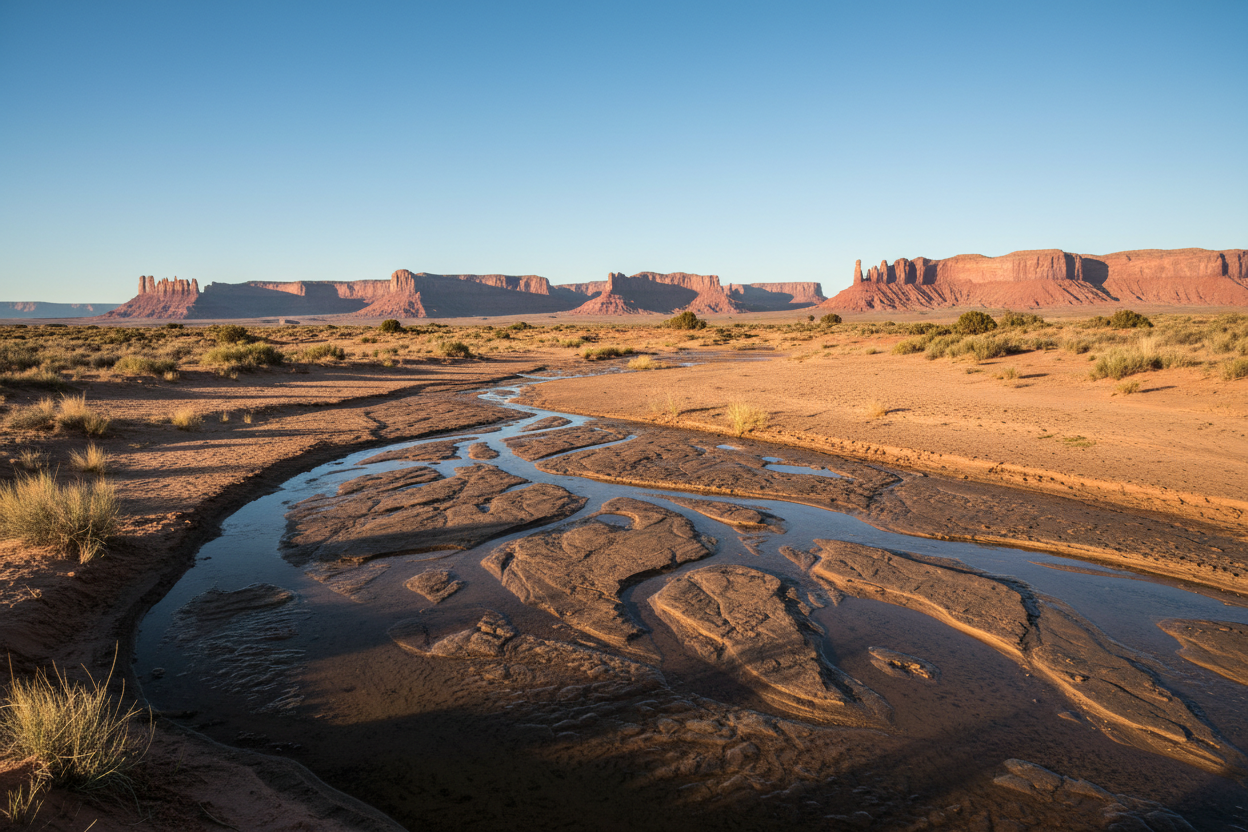
Quicksand has terrified moviegoers for decades. From Tarzan to Indiana Jones, it's portrayed as a deadly trap that can swallow you whole. Personally, I was never the same after poor Artax sank into the Swamps of Sadness in The NeverEnding Story. But recent warnings about actual quicksand conditions in Glen Canyon National Recreation Area remind us that this phenomenon is very real and increasingly common in certain environments.
According to a recent Outside Magazine article, rangers have issued warnings about quicksand forming along the shores of Lake Powell as water levels drop. This isn't Hollywood drama. It's physics and environmental science converging in ways that create genuine hazards and fascinating teaching opportunities.
What Actually Is Quicksand?
Let's get granular here (and yes, we're talking about actual grains of sand). Quicksand isn't a special type of sand. It's ordinary sand that has become saturated with water in a way that dramatically changes its physical properties.
Under normal conditions, sand grains rest against each other with air filling the spaces between them. This creates friction that allows the sand to support weight. But when water flows upward through sand (a process called liquefaction), it separates the grains and reduces friction between them. The result is a substance that looks solid but behaves like a liquid when disturbed.
The Physics of Sinking
Here's where it gets interesting from a physics standpoint. Quicksand is what scientists call a non-Newtonian fluid. Unlike water, which has constant viscosity, quicksand's viscosity changes based on the force applied to it.
When you step on quicksand, your weight and movement create stress that causes the sand-water mixture to behave more like a liquid. The sand grains separate, friction decreases, and you begin to sink. But here's the counterintuitive part: the more you struggle, the worse it gets. Rapid movement creates more disturbance, which further reduces the mixture's ability to support weight.
The good news? Quicksand is denser than the human body. You won't sink completely like in the movies. Most people will sink to about waist or chest depth before buoyancy stops the process. The bad news? The suction created by the sand-water mixture makes it extremely difficult to pull yourself out. Studies have shown that extracting a foot from quicksand can require force equivalent to lifting a medium-sized car.
Why Glen Canyon? The Environmental Difference
The quicksand situation at Glen Canyon isn't random. It's a direct result of environmental changes tied to water management and climate.
Lake Powell, created by the Glen Canyon Dam in 1963, has experienced dramatic water level fluctuations in recent years due to prolonged drought and increased water demand. As the lake recedes, it exposes sediment that has been underwater for decades. This sediment is often fine-grained and saturated, creating perfect conditions for quicksand formation.
The process works like this: groundwater continues to flow through the newly exposed sediment, moving upward toward the surface. This upward water flow prevents the sand grains from settling and compacting. The surface may look dry and solid, but just beneath lies saturated, unstable material waiting to liquefy under pressure.
This phenomenon illustrates several environmental science concepts: how human water management affects landscapes, how climate change influences water availability, and how ecosystems and physical environments respond to changing conditions over time.
Density, Buoyancy, and Viscosity
Quicksand provides a real-world demonstration of concepts that often feel abstract in textbooks.
Density: Quicksand typically has a density around 2.0 grams per cubic centimeter, while the human body averages about 1.0 g/cm³. This density difference is why you float rather than sink completely. It's the same principle that keeps ships afloat, just in a much more viscous medium.
Buoyancy: Archimedes' principle applies here. An object submerged in a fluid experiences an upward force equal to the weight of the fluid it displaces. Because quicksand is denser than your body, you displace enough of it to create sufficient buoyant force to keep you from sinking completely.
Viscosity: The resistance to flow in quicksand is much higher than in water. This high viscosity is what makes escape so difficult. Moving through quicksand requires overcoming significant resistance, and rapid movement only increases that resistance by creating more disturbance in the sand-water mixture.
The Role of Water Flow and Pressure
Understanding groundwater dynamics is crucial to understanding quicksand formation. Water doesn't just sit in sand. It moves through it, driven by pressure gradients and gravity.
In areas where water flows upward (artesian conditions), the upward force can overcome the weight of the sand grains above, keeping them suspended. This is similar to how a fluidized bed works in industrial applications, where gas or liquid flowing upward through particles causes them to behave like a fluid.
When the upward water pressure decreases (perhaps due to seasonal changes or shifting groundwater levels), the quicksand can suddenly stabilize, trapping anything that was sinking in it. Conversely, increased water flow can turn seemingly solid ground into quicksand without warning.
Bringing Quicksand Science Into the Classroom
The physics and environmental science of quicksand offer rich opportunities for hands-on investigation and cross-disciplinary learning.
Modeling Non-Newtonian Fluids: Students can create their own non-Newtonian fluids using cornstarch and water (oobleck). This mixture demonstrates similar properties to quicksand: it resists rapid force but yields to slow, steady pressure. Students can investigate how the ratio of solid to liquid affects behavior, how temperature influences viscosity, and how different forces create different responses.
Density and Buoyancy Experiments: Using sand, water, and density cubes, students can model why objects sink to different depths in quicksand. They can calculate densities, predict sinking depth, and test their predictions. This connects abstract calculations to observable phenomena. A Cartesian Diver Apparatus can also illustrate buoyancy principles.
Environmental Impact Studies: The Glen Canyon situation provides a case study for discussing water management, climate change impacts, and how human activities create cascading environmental effects. Students can research Lake Powell's water level changes over time, investigate the causes of drought in the Southwest, and explore the trade-offs involved in dam construction and water allocation. A Liquefication Apparatus mimics this type of soil transformation during seismic activity.
Fluid Dynamics Demonstrations: Simple demonstrations with sand, water, and clear containers can show how water flow affects sand stability. Students can observe how upward water flow suspends sand grains and how the mixture responds to different types of disturbance.
Engineering Challenges: Task students with designing methods to escape quicksand or to stabilize quicksand-prone areas. This requires applying their understanding of forces, pressure, buoyancy, and material properties to solve a real-world problem.
Real-World Relevance Drives Engagement
What makes quicksand such a powerful teaching tool is its combination of familiar cultural references, genuine hazard, and complex science. Students have seen quicksand in movies. They may have heard about the Glen Canyon warnings. This existing knowledge creates immediate engagement and motivation to understand the real science behind the phenomenon.
The interdisciplinary nature of quicksand science also allows connections across physics, earth science, environmental science, and even mathematics. Students can explore forces and motion, study sediment properties and groundwater flow, investigate environmental change and human impacts, and calculate densities, pressures, and forces.
When students understand that quicksand isn't movie magic but rather a predictable result of specific physical and environmental conditions, they begin to see science as a tool for making sense of the world around them. They learn that understanding principles like density, viscosity, and fluid dynamics isn't just about passing tests. It's about explaining real phenomena and potentially saving lives.
The next time your students encounter quicksand in a movie, they'll know the real story. And that knowledge might just stick with them longer than any textbook definition ever could.