Next week (April 19-25), we're celebrating Earth Day with 20% off our entire Earth Science collection. Don't miss out on that, but more importantly: don't miss out on the science of the outdoors during the warm months. That's right, camping season is the ultimate way to spend time in nature's laboratory, and whether you're an educator looking to take learning outside, a home scientist in your back yard, or simply a curious camper, these are the concepts worth knowing before you head into the woods.
The Physics of a Tent
You might think an upright tent holds pretty mundane science, but a well-pitched tent is a quiet engineering triumph. The forces keeping it standing are the same ones engineers think about when designing bridges and aircrafts: tension, aerodynamics, and the distribution of load.
Most modern tents use a system of flexible poles that create an arch. The poles are under compression, pushing outward against the tent fabric, which is under tension, pulling inward. These opposing forces create a stable structure that can resist wind and rain. The stakes driven into the ground anchor the system, transferring lateral wind loads into the earth rather than allowing the tent to move.
Wind is the primary enemy of a tent. When wind strikes a curved surface, it accelerates over the top (Bernoulli's principle), creating lower pressure above the tent than below it. This generates an upward lift force, the same principle that keeps aircraft aloft. A poorly staked tent in high wind doesn't just blow sideways. It can actually lift. Proper staking at the correct angle (roughly 45 degrees away from the tent, into the direction of anticipated wind) maximizes the holding force in the soil.
Soil type matters too. Sandy soil has low cohesion and poor stake-holding ability. Rocky or clay-rich soil holds stakes far more securely. Understanding the geology of your campsite is practical knowledge, not just academic.
Fire Science: The Maillard Reaction and the Chemistry of Cooking Outdoors
The campfire is the heart of the camping experience, and it's also a chemistry lab running at several hundred degrees.
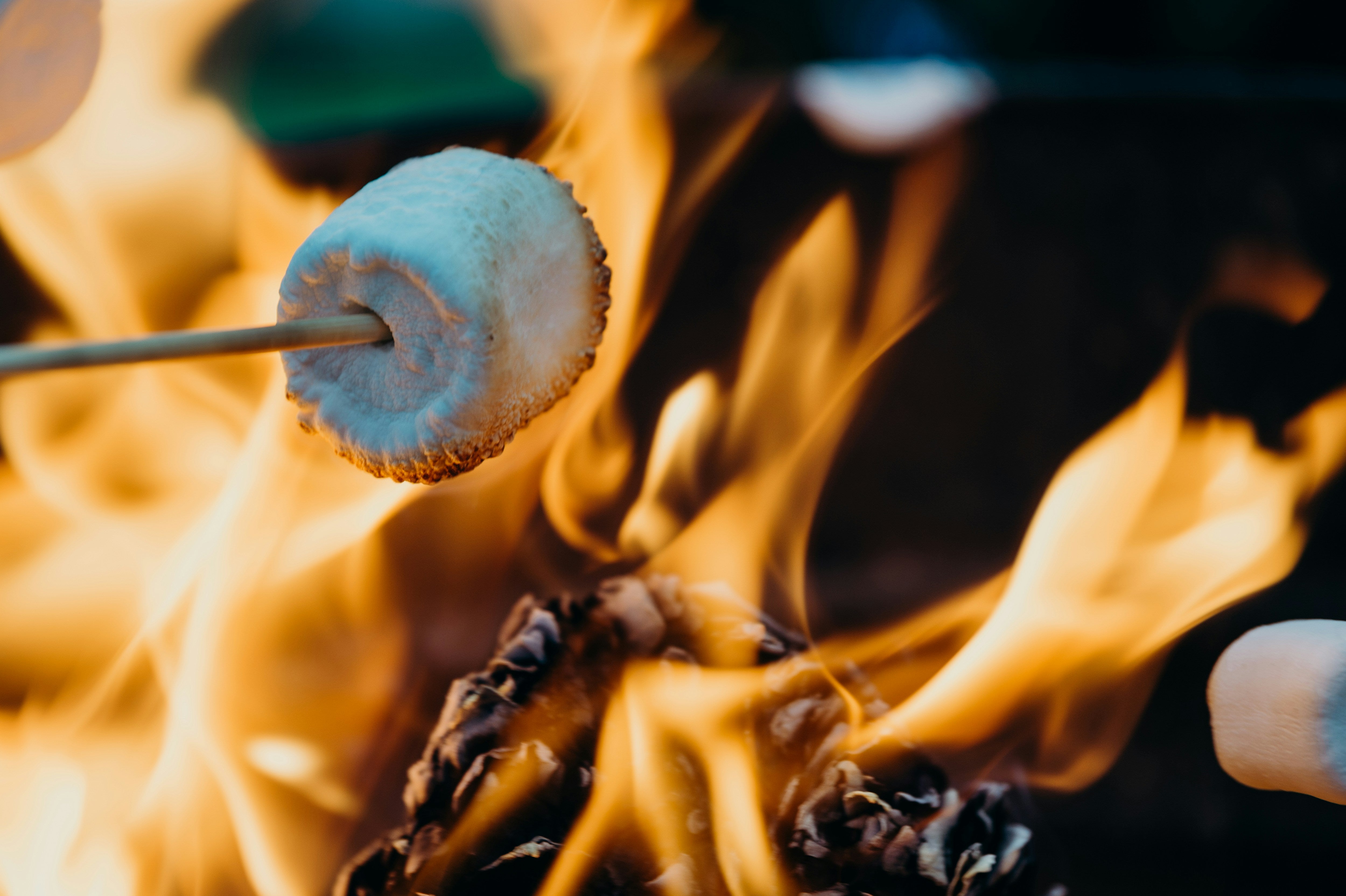
When you roast a marshmallow (or a hot dog, or anything with protein and sugar), you're triggering the Maillard reaction, a complex series of chemical reactions between amino acids and reducing sugars that occur at temperatures above roughly 280 degrees Fahrenheit (140 degrees Celsius). The result is the browning, the crust, the hundreds of new flavor compounds that make roasted food taste fundamentally different from raw or boiled food. It's not caramelization, which is a separate process involving only sugars. The Maillard reaction requires both protein and sugar, which is why a marshmallow browns differently than a plain sugar cube.
The fire itself is a rapid oxidation reaction, combustion, releasing energy stored in chemical bonds as heat and light. Wood is primarily cellulose and lignin. When heated sufficiently, these compounds break down and react with atmospheric oxygen, releasing carbon dioxide, water vapor, and energy. The color of the flame tells you about temperature: red and orange flames are cooler (around 1,000 to 1,200 degrees Fahrenheit), while blue flames indicate higher temperatures and more complete combustion.
Campfire smoke follows convection currents, which is why it always seems to find you no matter where you sit. Hot gases rise from the fire, cool as they ascend, and are pushed by ambient wind. The smoke follows the path of least resistance, which is often directly toward the nearest seated human.
Atmospheric Science in the Field
Experienced campers develop an intuitive sense for weather, but that intuition is built on real atmospheric science. Learning to read the sky, the wind, and the humidity can be the difference between a great trip and a miserable one.
Cloud types as weather indicators: Cumulus clouds (the puffy, white, flat-bottomed ones) generally indicate fair weather when they're small and widely spaced. When they grow tall and dark into cumulonimbus formations, a thunderstorm is developing. Cirrus clouds (thin, wispy, high-altitude streaks) often precede a warm front by 24 to 48 hours, signaling incoming rain. Stratus clouds (low, gray, uniform layers) typically bring drizzle and overcast conditions.
A Cloud Forming Apparatus demonstrates the physics of cloud formation in a bottle, showing how pressure changes cause water vapor to condense around particles. It's a perfect pre-trip classroom activity that makes cloud identification in the field much more meaningful.
Barometric pressure and weather prediction: Falling barometric pressure generally indicates deteriorating weather. Rising pressure signals improving conditions. Our Weather Globe Barometer uses a sealed liquid-filled globe to make pressure changes visible without electronics. The spout level rises when pressure drops and falls when pressure rises, a simple and elegant demonstration of atmospheric physics that works just as well on a campsite picnic table as in a classroom.
Humidity and the dew point: Dew forms when surfaces cool below the dew point, the temperature at which air becomes saturated with water vapor and condensation begins. On clear nights, ground-level surfaces radiate heat rapidly and can cool well below the dew point, leaving everything soaked by morning. A Psychrometer measures relative humidity using wet and dry bulb thermometers, the same principle used in professional meteorology. Students and campers can use it to calculate dew point and predict whether morning dew (or frost) is likely.
Wind direction and speed: Wind direction is one of the most useful pieces of weather information available to a camper. In the Northern Hemisphere, winds rotating counterclockwise around a low-pressure system bring storms. A Wind Vane and an Anemometer turn wind observation into quantitative data, and both are rugged enough for field use. Tracking wind speed and direction over the course of a day builds real meteorological intuition.
The Science of Navigation
A compass needle aligns with Earth's magnetic field, pointing toward magnetic north rather than true geographic north. The difference between the two, called magnetic declination, varies by location and must be accounted for when using a topographic map. In some parts of North America, declination can be 20 degrees or more, enough to send a navigator significantly off course over a long distance.
A Lensatic Compass and Orienteering Compass are both excellent tools for teaching and practicing navigation. The orienteering compass is particularly well-suited for map-and-compass work, with a transparent baseplate that allows the map to be read through it while taking bearings.
Topographic maps add another layer of earth science literacy. Contour lines represent lines of equal elevation, and learning to read them transforms a flat piece of paper into a three-dimensional landscape. Closely spaced contour lines indicate steep terrain. Widely spaced lines indicate gentle slopes. V-shaped contour patterns pointing uphill indicate valleys and stream channels. This is geology and geography made practical.
Clinometers measure angles of elevation and slope, useful for estimating the height of trees, the steepness of terrain, and the angle of a hillside. It's a simple instrument with a surprising number of field applications.
Reading the Landscape
Every campsite sits on geology, and that geology shapes everything from the soil type to the water sources to the rock formations visible on nearby ridges. Learning to read rocks and minerals in the field transforms a hike into a geological timeline.
Sedimentary rocks, formed from compressed layers of ancient sediment, often contain fossils and tell stories of ancient seas, rivers, and forests. Igneous rocks, cooled from magma, speak to volcanic history. Metamorphic rocks have been transformed by heat and pressure deep within the Earth and often display dramatic foliation and banding.
Mineral Collections and Rock Study Kits are ideal for pre-trip preparation, helping students and enthusiasts learn to identify common rock types before encountering them in the field. Mineral Test Kits go further, providing the tools to perform hardness tests, streak tests, and acid tests on field-collected samples. Bring a hand lens and a streak plate on your next hike and you'll never look at a rock the same way again.
Hydrology in the Field
Water is the most critical resource at any campsite, and understanding its behavior in the landscape is both practically useful and scientifically fascinating.
Streams and rivers follow paths determined by gravity and the underlying geology. Water erodes soft rock faster than hard rock, which is why rivers often follow fault lines and why waterfalls form where resistant rock caps softer material below. The turbidity (cloudiness) of a stream tells you about upstream conditions: high turbidity after rain indicates active erosion and sediment transport.
Dew, fog, and precipitation are all manifestations of the same atmospheric water cycle. Understanding how water moves from surface to atmosphere and back, the hydrological cycle, gives campers a framework for predicting morning conditions, understanding fog formation in valleys, and appreciating why certain campsites are wetter than others.
Entomology After Dark
Insects are the most abundant animals on Earth, and a campsite after dark is one of the best places to observe them. Moths navigate by maintaining a fixed angle to light sources, which is why they spiral toward campfire flames and lanterns. Fireflies use bioluminescence, a chemical reaction between luciferin and luciferase enzymes, to produce light for mating signals. Different species flash at different rates and patterns, and learning to distinguish them is a genuine field science skill.
Butterfly Nets are built for field collection and observation. Sweep netting through meadow vegetation at dusk reveals an astonishing diversity of insects that are invisible during the day.
Camping for Everyone: Choosing Your Level of Adventure
One of the most important things to understand about camping is that it exists on a spectrum. There is no single right way to experience the outdoors, and the barriers to entry are lower than many people assume.
Car camping is the most accessible entry point. You drive to a designated campsite, often with amenities like restrooms, running water, fire rings, and picnic tables. National and state park campgrounds, KOA campgrounds, and county parks offer this experience across the country. You can bring as much gear as your vehicle can carry, which means comfortable sleeping arrangements, full cooking setups, and everything you need for a relaxed outdoor experience. This is an excellent starting point for families, first-time campers, and anyone who wants to test their comfort level before committing to more remote experiences.
Backpacking adds the element of human-powered travel. Everything you need for multiple nights must fit in a pack you carry on your back. Weight becomes a critical variable, and gear selection becomes a science in itself. Backpacking opens up wilderness areas inaccessible by vehicle and rewards the effort with experiences that are genuinely difficult to replicate any other way.
Glamping (glamorous camping) sits at the other end of the spectrum, offering the outdoor setting with significantly more comfort: furnished tents, yurts, cabins, or even converted vehicles with real beds, electricity, and sometimes full kitchens. For people who want the experience of waking up in nature without the logistics of traditional camping, glamping is a completely valid choice.
Resources for Getting Started
Check out these sites to plan a safe, responsible camping trip at any experience level.
Recreation.gov is the official reservation system for federal campgrounds, including national parks, national forests, and Bureau of Land Management sites. You can search by location, amenity type, and availability.
Reserve America covers state park campgrounds across most of the US, with a single search interface for finding and booking sites.
The Dyrt is a community-driven camping app with reviews, photos, and GPS coordinates for both developed and dispersed camping areas. Particularly useful for finding free dispersed camping on public lands.
Leave No Trace Center for Outdoor Ethics provides the seven principles of responsible outdoor recreation, essential reading for anyone venturing beyond a developed campground. The principles cover everything from waste disposal to campfire management to wildlife interaction.
AllTrails is the most comprehensive trail database available, with user reviews, difficulty ratings, elevation profiles, and downloadable offline maps. Invaluable for planning hikes from a base camp.
US Forest Service and Bureau of Land Management (blm.gov) both maintain websites with information about dispersed camping regulations, fire restrictions, and permit requirements for specific areas. Always check current fire restrictions before your trip.
National Park Service covers all 63 national parks with detailed information on camping options, reservations, fees, and regulations.
Take the Science Outside
The outdoors is the original science classroom. Every camping trip is an opportunity to observe weather systems forming in real time, read geological history in exposed rock faces, investigate water quality in a mountain stream, and watch ecological relationships play out around a campfire. The concepts that fill earth science curricula are alive and observable in every forest, desert, and meadow.
This Earth Day, we're celebrating that connection with 20% off our entire Earth Science collection through next week. Whether you're equipping a classroom for outdoor learning or building your own field kit, there's no better time to invest in the tools that bring science outside where it belongs.