When we published our Artemis II launch breakdown on April 1st, four astronauts were just beginning their journey. Now the mission is well underway, and the numbers coming back from NASA are extraordinary. With history made, the Orion Spacecraft is planned to splash down off the coast of San Diego around 5:07 p.m. PDT Friday, April 10.
If you haven't read the launch post, start there for the full breakdown of the SLS rocket specs, Orion spacecraft details, and the physics of the launch itself. Here, we break down the incredible achievements of this mission and the physics of the planned reentry.
The Numbers So Far: A Mission in Stats
Artemis II has already rewritten the record books. Here's a snapshot of where things stand:
Maximum distance from Earth: Approximately 252,756 miles (406,771 km), making this the farthest any humans have traveled from Earth. The previous record was set by the Apollo 13 crew in 1970, who reached about 248,655 miles from Earth during their emergency free-return trajectory. Artemis II has surpassed that by a significant margin.
Total distance traveled: Over the course of the mission, Orion is expected to travel 695,081 miles, tracing a figure-eight path around Earth and Moon before returning home.
Speed: At various points in the mission, Orion has traveled at speeds exceeding 24,500 mph (39,400 km/h) relative to Earth. During the translunar coast phase, the spacecraft slows considerably as Earth's gravity continues to act on it, before lunar gravity begins to dominate.
Communication delay: At maximum distance, radio signals traveling at the speed of light take approximately 1.35 seconds to reach the spacecraft one way. While modest compared to deep space missions, it's a tangible reminder of the distances involved.
Crew time in space: The four astronauts, Reid Wiseman, Victor Glover, Christina Koch, and Jeremy Hansen, have spent approximately 10 days in a habitable volume of 316 cubic feet, roughly the size of a large SUV interior, while traveling farther from home than any humans in history.
What It's Like Out There: The Environment Beyond the Moon
The space environment at lunar distance is dramatically different from low Earth orbit, where the International Space Station operates under the partial protection of Earth's magnetic field.
Radiation exposure: Beyond Earth's magnetosphere, the crew is exposed to galactic cosmic rays and potential solar particle events at levels significantly higher than ISS astronauts experience. Orion's crew module includes radiation shielding, and the mission has been timed to avoid known periods of high solar activity, but radiation management remains one of the central challenges of deep space human exploration.
Communication and navigation: Artemis II relies on NASA's Deep Space Network, a global array of large radio antennas, for communication and tracking. The precision required to maintain contact with a spacecraft moving at tens of thousands of miles per hour at lunar distances is itself a remarkable feat of applied physics and engineering.
Psychological isolation: At maximum distance, Earth appears as a small, bright disk. The crew can cover it with a thumb held at arm's length. This perspective, what astronauts call the overview effect, has been described by every human who has experienced it as profoundly transformative. From out there, the boundaries and divisions that define life on Earth become invisible. What remains is a single, fragile, luminous sphere.
The Free-Return Trajectory
As we covered in the launch post, Artemis II follows a free-return trajectory, using the Moon's gravity to slingshot the spacecraft back toward Earth without requiring a major propulsion burn. Watching this play out in real time illustrates something that can be difficult to convey in a classroom: orbital mechanics is not intuitive.
The spacecraft doesn't fly in a straight line. It follows a curved path shaped by the gravitational fields of two massive bodies, Earth and Moon, while also carrying the momentum imparted by the SLS at launch. The trajectory was calculated months in advance, and the precision required is staggering. A velocity error of just a few feet per second at translunar injection could result in a trajectory that misses the Moon entirely or fails to return to Earth on the correct path.
This is why the mission carries the European Service Module with its 33,000-pound-thrust main engine: for course corrections. Small burns at precise moments in the trajectory fine-tune the path, compensating for any deviations from the planned route. It's the same principle as adjusting the aim of a thrown ball mid-flight, except the ball is traveling at 24,000 mph and the target is a moving point in space 239,000 miles away.
Coming Home: The Physics of Reentry
The most physically demanding phase of the entire mission happens in the final 20 minutes. Reentry from lunar distance is categorically different from reentry from low Earth orbit, and understanding why requires a look at the physics of kinetic energy and atmospheric drag.
The Velocity Problem
When Orion reenters Earth's atmosphere, it will be traveling at approximately 25,000 mph (40,000 km/h). This is lunar return velocity, significantly faster than the roughly 17,500 mph at which the ISS orbits. The difference matters enormously because kinetic energy scales with the square of velocity. An object moving twice as fast carries four times the kinetic energy. Orion returning from the Moon carries roughly twice the kinetic energy of a spacecraft returning from low Earth orbit, and all of that energy must be dissipated before the spacecraft can safely deploy parachutes and splash down.
The Heat Shield
Orion's heat shield is the largest ablative heat shield ever built, at 16.5 feet in diameter. The material, called Avcoat, works through a process called ablation: as the shield surface heats up from atmospheric friction, the material chars, melts, and vaporizes in a controlled way, carrying thermal energy away from the spacecraft rather than conducting it inward toward the crew.
At peak heating, the shield surface reaches approximately 5,000 degrees Fahrenheit (2,760 degrees Celsius), hotter than the melting point of steel. The crew module interior, separated from that inferno by the heat shield and insulation, remains at a survivable temperature. The engineering margin between crew survives and crew does not survive is measured in inches of carefully engineered material.
The Skip Reentry Technique
NASA has designed Artemis II to use a skip reentry trajectory, a technique that makes the physics of coming home even more interesting. Rather than plunging directly into the atmosphere, Orion will dip into the upper atmosphere, use aerodynamic lift to skip back out briefly, and then reenter for the final descent.
This technique serves two purposes. First, it distributes the heating load over a longer period, reducing peak temperatures on the heat shield. Second, it allows much greater control over where the spacecraft lands, enabling a splashdown in a specific target zone in the Pacific Ocean rather than wherever a direct ballistic reentry would deposit it.
The skip reentry requires precise guidance and control during the atmospheric skip phase. Orion's reaction control thrusters fire in carefully timed sequences to maintain the correct attitude and lift vector throughout. It's an elegant solution to a brutal physics problem.
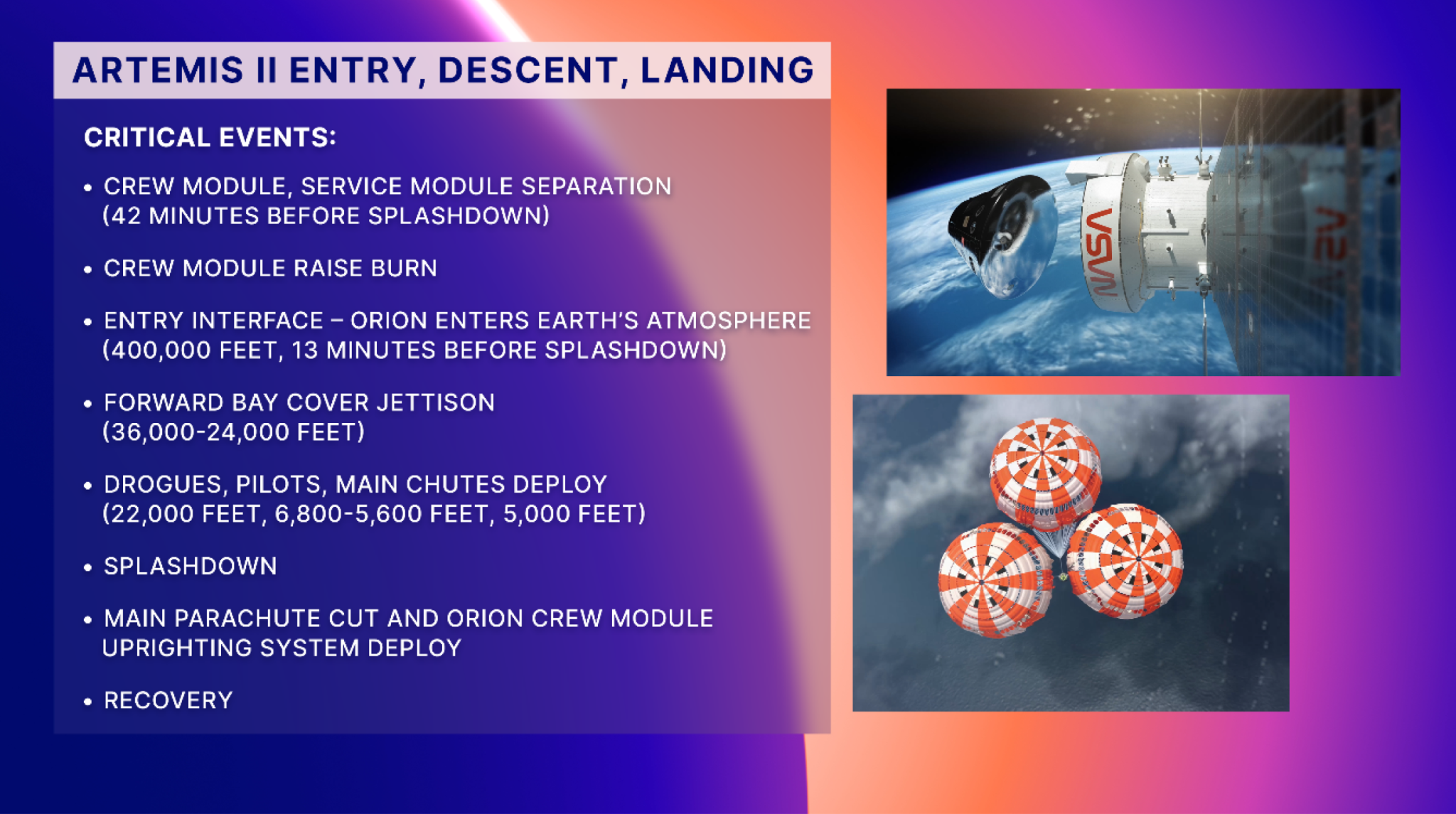 Artemis II infographic showcasing the missions entry, descent, and landing milestones. This graphic was presented by Artemis II Flight Director Rick Henfling during the mission status briefing to the media and public on April 8, 2026 at NASA’s Johnson Space Center in Houston. - NASA
Parachute Deployment and Splashdown
After the skip reentry, Orion deploys a sequence of parachutes in stages. First, two drogue parachutes slow the spacecraft from supersonic speeds. Then three main parachutes, each 116 feet in diameter, deploy to reduce the descent rate to approximately 17 mph at splashdown. The crew module hits the Pacific Ocean surface at that speed, which is survivable but not gentle. Recovery ships from the US Navy will retrieve the crew module and astronauts within minutes of splashdown.
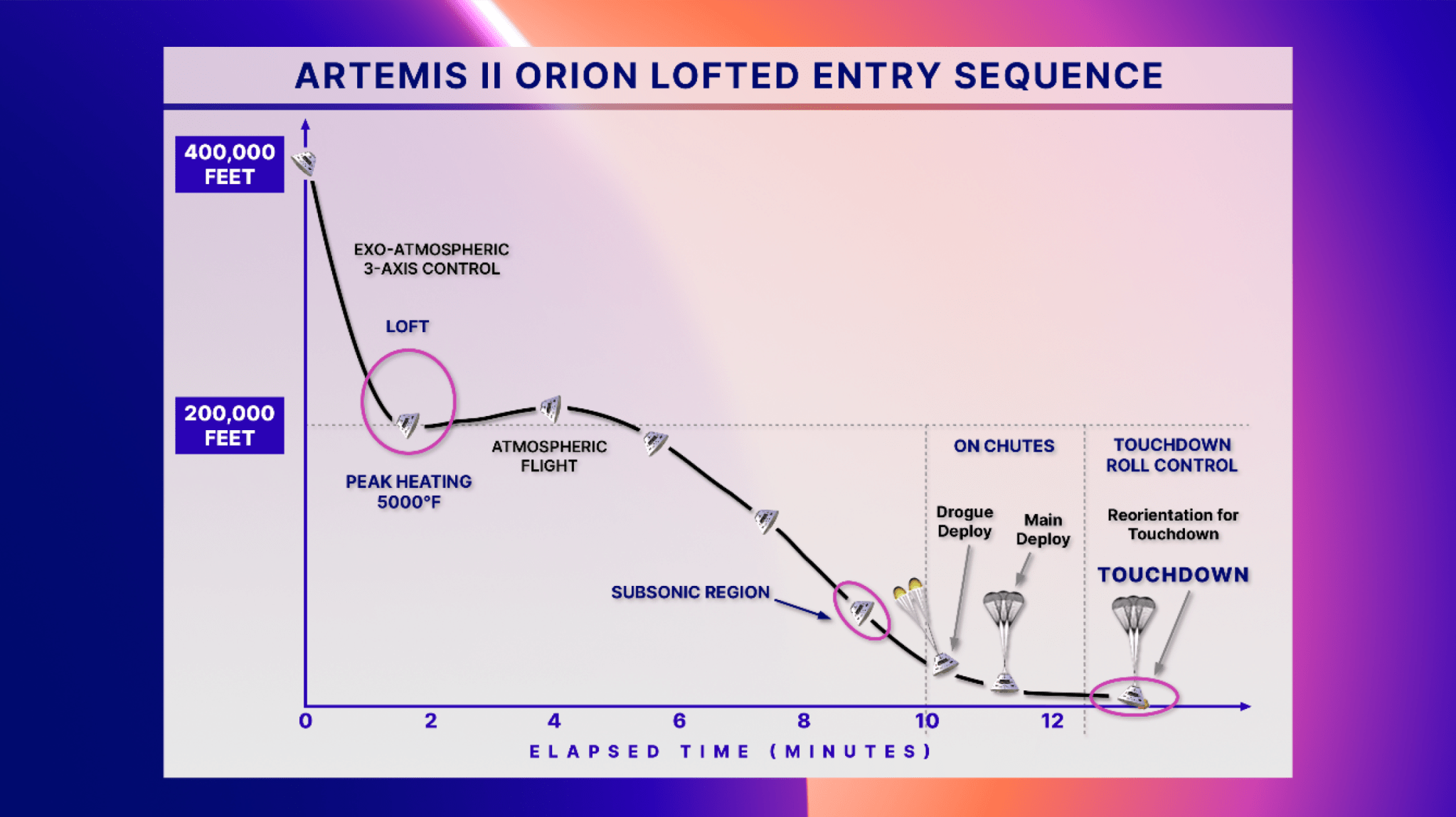 Infographic featuring the Artemis II Orion lofted entry sequence. This graphic was presented by Artemis II Flight Director Rick Henfling during the mission status briefing to the media and public on April 8, 2026 at NASA’s Johnson Space Center in Houston. - NASA
What Artemis II Proves
Beyond the records and the spectacle, Artemis II is fundamentally a data collection mission. Every sensor reading, every system performance metric, every crew physiological measurement feeds into the planning for Artemis III, which aims to land humans on the lunar surface for the first time since Apollo 17 in 1972.
The skip reentry data alone is invaluable. No crewed spacecraft has used this technique before at lunar return velocities. The heat shield performance data will validate models that engineers have been running for years. The radiation exposure measurements will inform shielding designs for future long-duration missions.
In this sense, Artemis II is less a destination than a question: can we do this safely, reliably, and repeatably? The answer, so far, appears to be yes.
Classroom Connections: Reentry Physics in Action
The reentry phase of Artemis II offers some of the richest classroom physics connections of the entire mission.
Kinetic energy and heat: The conversion of kinetic energy to thermal energy during reentry is a direct application of energy conservation principles. Students can calculate the kinetic energy of Orion at reentry velocity and compare it to the energy released by familiar phenomena, connecting abstract equations to a real, observable event.
Our Heat Radiation Kit lets students investigate how thermal energy is emitted and absorbed by different surfaces, connecting directly to the heat shield's role in managing thermal energy during reentry. Pair it with our Thermo-Sensitive Reusable Cloth for vivid visual demonstrations of heat transfer and temperature gradients that make the invisible physics of reentry visible in the classroom.
For insulation and thermal protection discussions, our Ice Melt Blocks are a tangible, hands-on example of the same engineering principle behind Orion's thermal protection system: using low-conductivity materials to prevent heat from reaching sensitive components. Students can test different materials as insulators and compare their effectiveness, mirroring the material science challenges NASA engineers faced in designing the heat shield.
Projectile motion and trajectory: The skip reentry is essentially a controlled projectile motion problem at hypersonic speeds. Several tools in our Force & Motion collection illustrate these principles. They allow students to investigate launch angle, velocity, and trajectory in a controlled setting, building the conceptual foundation for understanding how engineers design reentry corridors.
The Artemis program is unfolding in real time, and every phase of it is a physics lesson. Whether you're tracking the mission from a classroom, a home lab, or just a curious corner of the internet, the science happening right now is the same science that fills textbooks. It's just moving at 25,000 miles per hour.