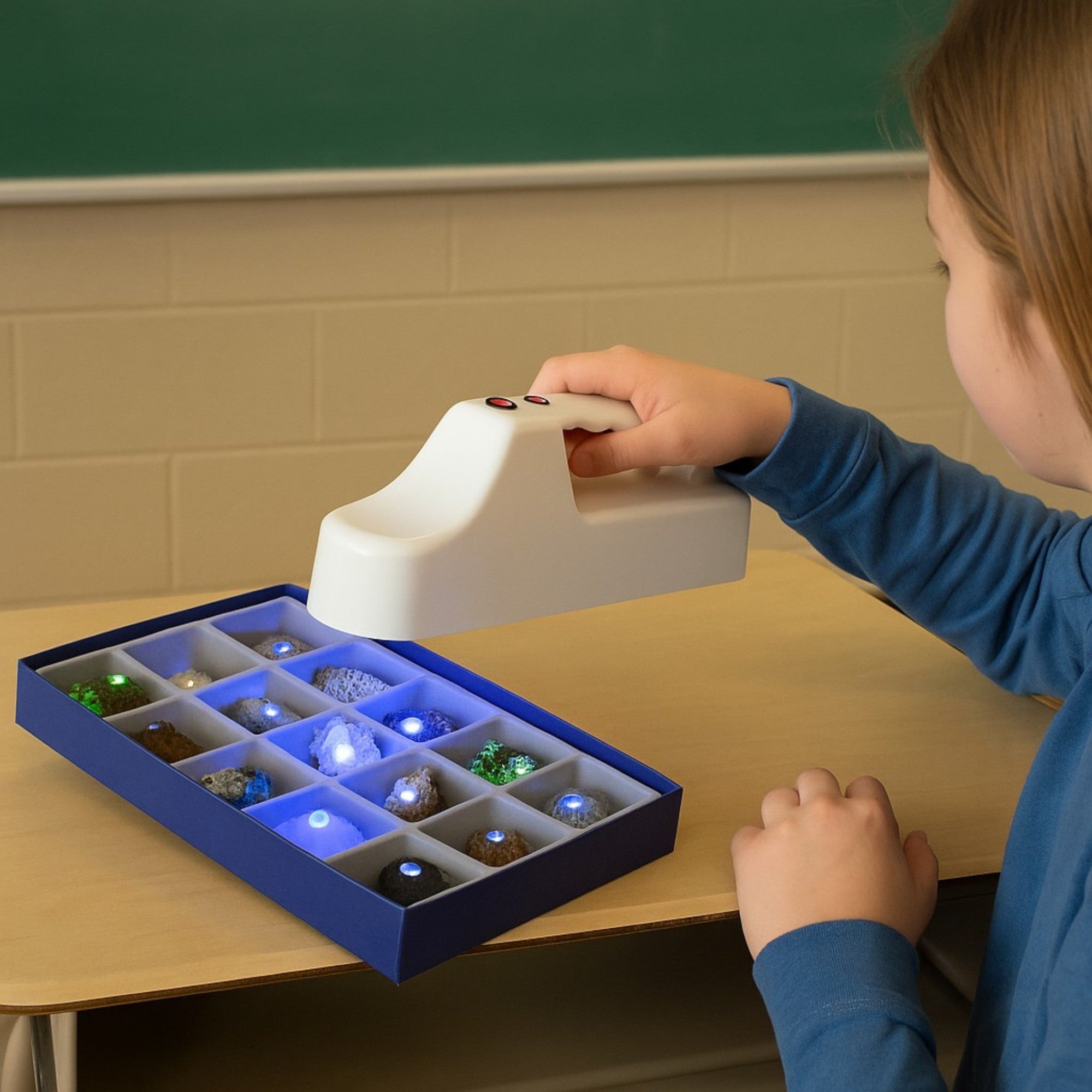
When you shine ultraviolet light on certain minerals and watch them burst into brilliant greens, reds, and oranges, you're witnessing one of nature's most captivating optical phenomena: fluorescence. Our Fluorescent Mineral Kit with UV Light brings this remarkable science directly into the classroom, offering students a hands-on window into atomic physics, mineralogy, and the electromagnetic spectrum.
What Is Fluorescence?
Fluorescence is a form of luminescence: the emission of light by a substance that has absorbed electromagnetic radiation. The term comes from fluorite, one of the first minerals in which this property was extensively studied. Unlike phosphorescence (which continues after the light source is removed), fluorescence occurs only while the material is being illuminated.
At the atomic level, here's what happens: When UV photons strike a fluorescent mineral, electrons in certain atoms absorb that energy and jump to higher energy states. These excited electrons are unstable and quickly return to their ground state, releasing the absorbed energy as visible light photons. Because some energy is lost as heat during this process, the emitted light has a longer wavelength (lower energy) than the absorbed UV light. This principle is known as Stokes' Law.
Why Different Wavelengths Matter
Our kit includes a dual-wavelength UV lamp with both shortwave (254nm) and longwave (365nm) settings, and this distinction is crucial for understanding mineral fluorescence.
Different minerals contain different "activator" elements: trace impurities like manganese, chromium, or rare earth elements that create the fluorescent response. These activators respond to different wavelengths of UV light. Some minerals fluoresce brilliantly under longwave UV but show little response to shortwave, while others do the opposite. Some minerals even display different colors depending on which wavelength excites them.
For example, calcite containing manganese may glow red or orange under longwave UV, while willemite (zinc silicate) produces a vibrant green fluorescence under shortwave UV due to manganese activation. This wavelength-dependent behavior teaches students that light-matter interactions are highly specific and governed by quantum mechanical principles.
The Role of Crystal Structure and Impurities
Pure minerals rarely fluoresce. It's the "imperfections" (trace elements substituting into the crystal lattice) that create fluorescence. These activator ions create energy levels within the mineral's electronic structure that enable the absorption and re-emission process.
The host crystal structure also matters. The same activator element can produce different fluorescent colors in different mineral hosts because the surrounding atomic environment affects the energy levels available to electrons. This demonstrates a fundamental principle in materials science: properties emerge from both composition and structure.
Real-World Applications
Understanding fluorescence isn't just academically interesting. It has practical applications across multiple fields:
- Geology and Mining: Geologists use UV lamps to identify minerals in the field and locate ore deposits
- Gemology: UV fluorescence helps authenticate gemstones and detect treatments
- Forensic Science: Crime scene investigators use UV light to detect biological fluids and trace evidence
- Medicine: Fluorescence microscopy and fluorescent markers are essential tools in biological research
- Environmental Science: Fluorescent tracers help track water flow and contamination
Classroom Investigation Opportunities
With 15 different fluorescent mineral specimens, students can design controlled experiments: Does the same mineral always fluoresce the same color? How does distance from the UV source affect brightness? Can you predict which minerals will respond to which wavelength? What happens when you mix minerals?
These investigations align with NGSS standards in physical science (wave properties, electromagnetic radiation) and earth science (mineral properties, rock and mineral identification), while building scientific inquiry skills.
Safety Considerations
UV light, particularly shortwave UV, can damage eyes and skin with prolonged exposure. This kit is designed for supervised educational use, teaching students not only about fluorescence but also about laboratory safety protocols: an essential component of scientific literacy.
The Fluorescent Mineral Kit transforms abstract concepts about light, energy, and atomic structure into vivid, memorable experiences. When students see minerals glow in impossible colors, they're observing quantum mechanics in action and building the foundation for deeper understanding of how light and matter interact throughout our universe.