When Malaria Fights Back: How Genetic Mutations Can Make a Parasite Drug-Resistant
Medicine has given us powerful tools for fighting infectious diseases. But the organisms that cause those diseases aren't standing still.
They evolve.
A new study led by researchers at Brown University offers a striking example. Scientists studying malaria parasites in Uganda have identified a rapidly spreading group of genetic variants associated with decreased susceptibility to several important antimalarial drugs.
The discovery provides students with a real-world example of genetics, mutation, natural selection, evolution, parasitology, and modern genome sequencing all intersecting with an urgent global health problem.
It also raises an important question:
How can a treatment that once worked against a disease become less effective over time?
A recent Brown University report on malaria drug resistance takes us directly into the science behind that question.
What Causes Malaria?
Malaria is an infectious disease caused not by a bacterium or virus, but by a parasite.
Several species of the genus Plasmodium can cause malaria in humans. The parasite at the center of the Brown University research is Plasmodium falciparum, the species responsible for the most severe form of human malaria.
Malaria parasites have a complicated life cycle involving both humans and mosquitoes.
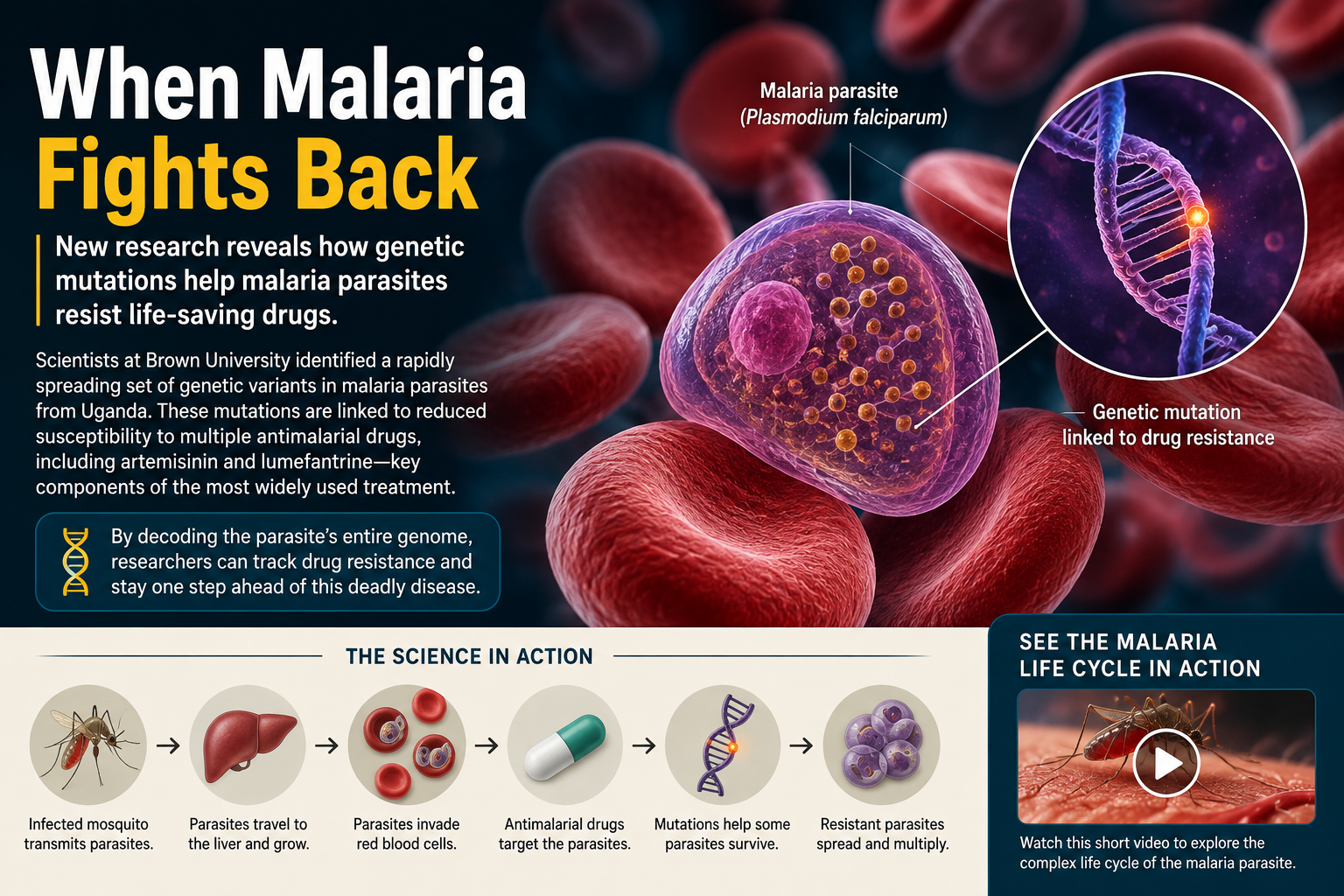
An infected female Anopheles mosquito can transmit parasites to a person when it takes a blood meal. The parasites eventually infect red blood cells, where they reproduce. Another mosquito can then pick up parasites while feeding on an infected person, allowing the cycle to continue.
That makes malaria an excellent classroom example of a disease involving interactions among a pathogen, host, and vector.
But it also creates an enormous challenge for medicine.
Scientists aren't just trying to treat infected patients. They are fighting an evolving parasite within a complex biological system.
How Do We Treat Malaria?
For roughly two decades, one of the primary treatments for uncomplicated malaria in Uganda has been artemether-lumefantrine, often abbreviated AL.
It belongs to a group of treatments known as artemisinin-based combination therapies, or ACTs.
The word combination is important.
Instead of relying on a single drug, the treatment combines artemether, an artemisinin derivative, with lumefantrine. Using drugs that attack the parasite in different ways can make treatment more effective and help reduce the likelihood that parasites resistant to one drug will survive.
But evolution doesn't stop simply because we're using two drugs.
Researchers have been observing signs that some malaria parasites are becoming less susceptible to these treatments.
The Brown University team wanted to understand why.
Searching an Entire Genome for Clues
To investigate, researchers analyzed malaria parasites collected from the blood of hundreds of infected people in Uganda.
Instead of looking only at a few previously known genes, the scientists used whole-genome sequencing.
A genome contains an organism's complete set of genetic information. Whole-genome sequencing allows researchers to examine enormous amounts of DNA and search for genetic differences that may be associated with a particular trait.
In this case, the trait was especially important:
Reduced susceptibility to antimalarial drugs.
Researchers identified a region of the malaria parasite genome containing 69 genes. Additional genetic analysis eventually pointed toward a linked set of variants involving three mutations and two deletions.
Of particular interest were mutations in a gene associated with a protein called PX1, or phosphoinositide-binding protein.
These genetic changes were associated with decreased susceptibility to artemisinin and lumefantrine, the two components of the commonly used combination therapy, as well as another antimalarial drug called mefloquine.
That made the discovery especially concerning.
Researchers weren't simply seeing a parasite becoming less susceptible to one drug. They had identified genetic variants associated with decreased susceptibility to multiple important antimalarial drugs.
What Does Drug Resistance Have to Do With Evolution?
This research provides a powerful real-world example of natural selection.
Mutations occur within populations.
Many mutations have little effect. Some may be harmful. Occasionally, however, a genetic change gives an organism an advantage in a particular environment.
Now imagine a population of malaria parasites being exposed to an antimalarial drug.
Parasites that are highly susceptible to the treatment are more likely to be eliminated.
But what happens if a few parasites carry genetic variants that allow them to survive the treatment more successfully?
Those surviving parasites may reproduce and pass their genetic variants to future generations.
Over time, variants that improve survival in the presence of a drug can become more common within the population.
The medicine hasn't caused the parasite to intentionally change. Instead, the treatment creates a selective pressure.
Parasites possessing advantageous genetic traits are more likely to survive and reproduce.
That's natural selection happening in a context with very real consequences.
Why the Speed of the Change Matters
One of the most concerning aspects of the research is how quickly the newly identified genetic variants appear to be spreading.
The researchers found evidence that the variant combination increased rapidly in Uganda.
That rapid increase matters because when a genetic variant becomes more common over a relatively short period, scientists can ask whether some form of selection may be favoring it.
In this case, researchers are concerned that the variants provide malaria parasites with an advantage when exposed to commonly used antimalarial treatments.
Brown researcher Dr. Jeffrey Bailey noted that the rapid spread suggests the mutations are important to the parasite's survival.
This is evolution that scientists can investigate through genetic data.
Instead of examining fossils from millions of years ago, researchers can sequence DNA from present-day organisms and track how particular variants change in frequency across populations and over time.
DNA Can Become a Public Health Tracking Tool
Finding a genetic variant associated with drug resistance isn't valuable only because it helps scientists understand how resistance works.
It can also give public health researchers something to look for.
Scientists already use molecular surveillance to monitor malaria parasites. By collecting samples and analyzing their genetic material, researchers can track mutations associated with resistance.
The newly identified PX1 variants could provide another molecular marker for those surveillance efforts.
Think of a molecular marker as a genetic warning sign.
If researchers know that a particular genetic pattern is associated with reduced drug susceptibility, they can test parasite populations in different locations to determine where that pattern is appearing and how quickly it is spreading.
That creates a fascinating connection between molecular biology and epidemiology.
A tiny change in DNA can potentially help scientists monitor a disease across entire regions.
What Is a Mutation?
The word mutation sometimes sounds dramatic, but its biological meaning is straightforward.
A mutation is a change in genetic material.
DNA is made from sequences of nucleotide bases. Changes to that sequence can take several forms. A nucleotide may be substituted for another. Genetic material may be inserted. Sections may be deleted.
The malaria research identified both specific mutations and deletions associated with reduced drug susceptibility.
Whether a genetic change matters depends on what it does.
Some mutations don't significantly alter an organism's traits. Others can change the structure or function of proteins, affect how genes are regulated, or influence how an organism responds to its environment.
Researchers are especially interested in the PX1 gene because the associated genetic changes appear to influence how malaria parasites respond to several drugs.
That creates another useful classroom question:
How can a change in DNA eventually change an organism's ability to survive?
The path from DNA to proteins to traits is one of the foundational ideas of modern biology.
Here, students can see that concept playing out in current scientific research.
Why Combination Therapy Matters
The discovery also provides an opportunity to discuss why doctors sometimes treat infectious diseases using more than one drug.
Imagine that a parasite has developed a genetic trait that helps it survive Drug A.
If treatment relies only on Drug A, those parasites have a significant advantage.
But if Drug A is combined with Drug B, surviving treatment becomes more difficult because the parasite must withstand multiple mechanisms of attack.
Combination therapy can therefore make it harder for resistance to spread.
However, the Brown research demonstrates why scientists still need to remain vigilant.
The identified genetic variants were associated with reduced susceptibility to multiple drugs, including both components of a commonly used combination treatment.
That doesn't mean the treatment has suddenly stopped working everywhere. The researchers emphasize that additional work is needed to determine how the variants affect actual treatment outcomes and how widely they have spread outside Uganda.
But it does mean scientists now have an important signal to watch.
From Blood Sample to Genome
The technology behind this discovery is almost as interesting as the discovery itself.
Researchers began with malaria parasites obtained from infected patients.
From those samples, scientists could analyze parasite DNA using genome sequencing.
Computational tools then allowed researchers to compare genetic information from many parasites, identify variants, and look for patterns associated with reduced drug susceptibility.
This is modern biology at work.
Microscopy, genetics, molecular biology, medicine, statistics, and computer science can all contribute to understanding a single infectious disease.
For students who think biology happens only at a lab bench, genomics offers a very different picture.
Today's biologists may spend as much time analyzing enormous datasets as looking through microscopes.
Bringing Malaria Biology Into the Science Classroom
Malaria provides educators with an unusually rich case study because so many biological concepts intersect within one disease.
Students can explore:
-
Parasites and host organisms
-
Mosquitoes as disease vectors
-
Red blood cells
-
Genetics and mutations
-
DNA sequencing
-
Natural selection
-
Evolution
-
Drug resistance
-
Epidemiology
-
Public health
Microscopy can provide a particularly useful classroom connection.
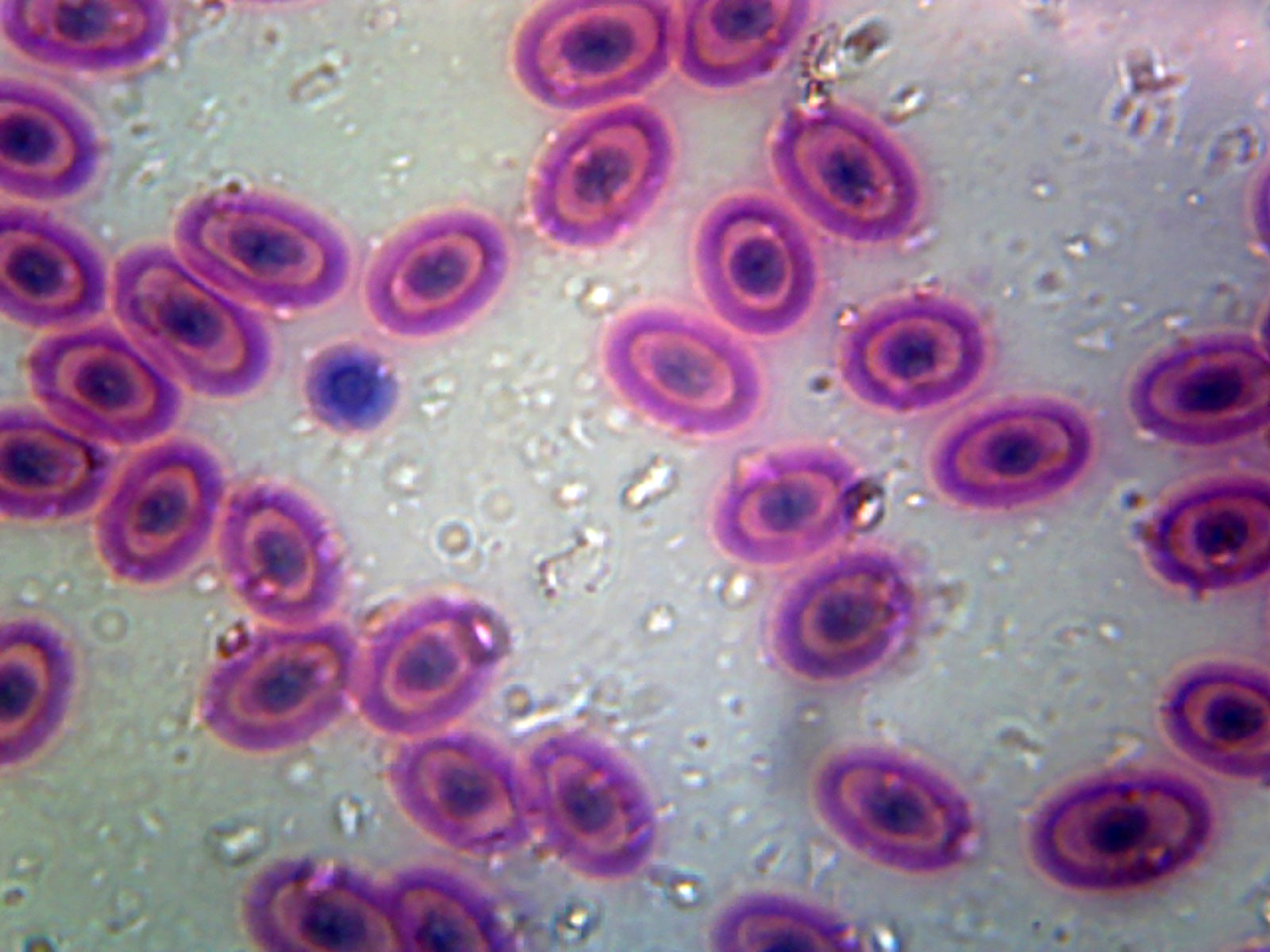
Malaria parasites have traditionally been identified by examining stained blood samples under a microscope. That means students can connect the abstract ideas of infection and parasitism with observable cellular structures.
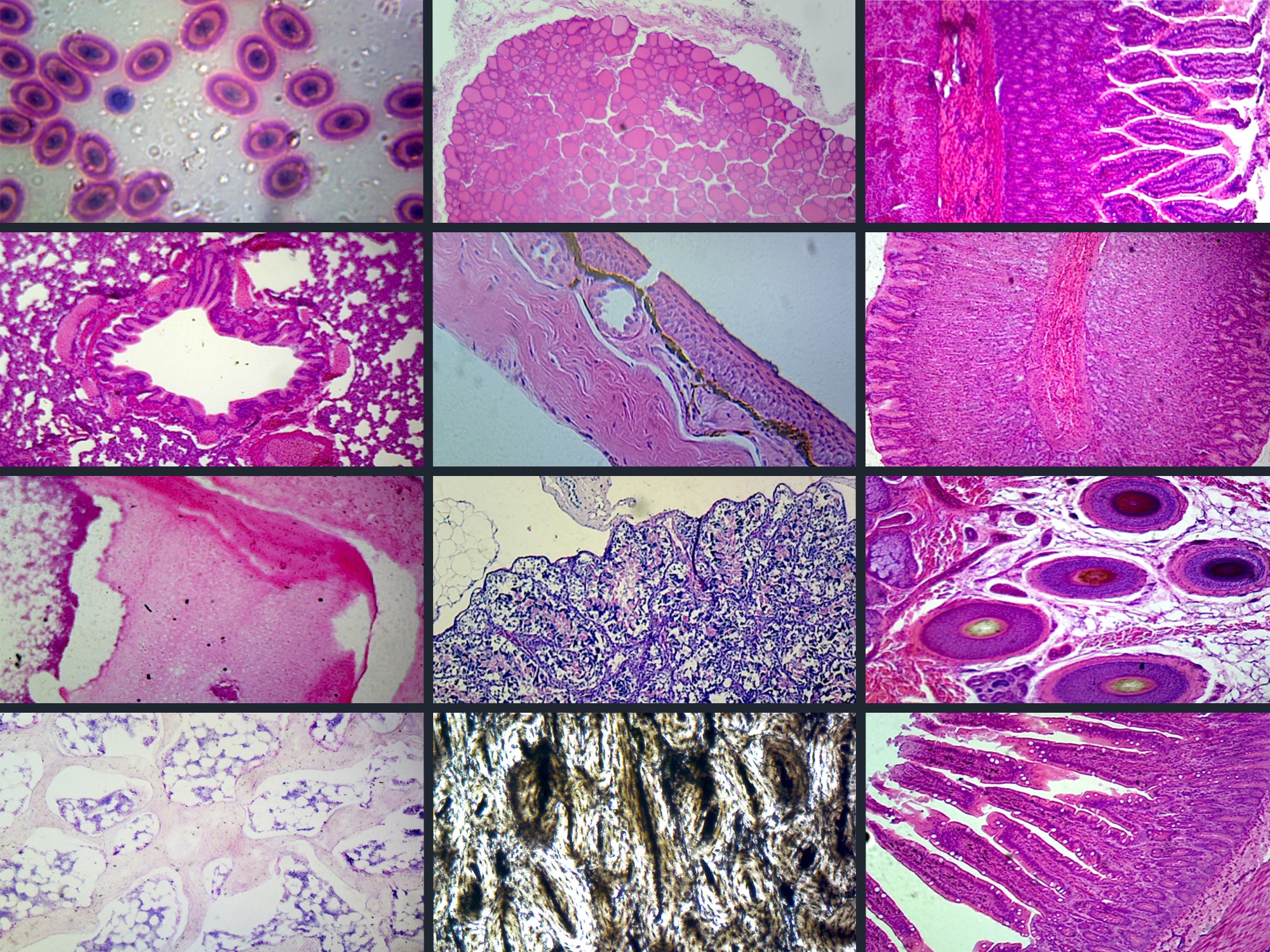
Go Science Crazy's collection of prepared microscope slides can help students develop the microscopy skills needed to investigate cells, microorganisms, and other biological specimens while learning how microscopy contributes to disease research.
A lesson could begin with normal blood cells and then introduce images or prepared specimens showing parasitized blood cells.
Students can compare what scientists can learn from microscopy with what they can learn from DNA sequencing.
That distinction is important.
A microscope can reveal structures and cells.
Genomic sequencing can reveal genetic differences that may be invisible under even powerful optical magnification.
Together, these technologies give scientists very different kinds of evidence.
Try This Classroom Discussion
After introducing the Brown University research, ask students to imagine that they are part of a public health team monitoring malaria.
Researchers have discovered a new genetic variant associated with decreased susceptibility to an important drug.
What should scientists do next?
Students might consider questions such as:
-
What is a mutation?
-
How could a mutation give a parasite a survival advantage?
-
Why doesn't every parasite immediately become drug-resistant?
-
How does natural selection change the frequency of genetic variants within a population?
-
Why might combination therapy slow the evolution of resistance?
-
What can microscopy tell researchers about malaria that DNA sequencing cannot?
-
What can genome sequencing reveal that microscopy cannot?
-
Why would scientists want to collect parasite samples from many locations?
-
How could researchers determine whether a resistance-associated mutation is spreading?
-
Why is discovering a molecular marker useful for public health?
This turns a current scientific discovery into a practical lesson about evolution happening in real time.
Evolution Isn't Just Something That Happened in the Past
Evolution is sometimes taught primarily through examples from Earth's distant history.
Malaria drug resistance demonstrates why that picture is incomplete.
Evolution is happening now.
Every generation introduces genetic variation into populations. Environmental pressures influence which organisms survive and reproduce. Over many generations, advantageous traits can become more common.
When the organism reproduces rapidly—as parasites and microorganisms often do—those evolutionary changes can become visible on human timescales.
That's why drug resistance is such an important teaching example.
It connects mutation, heredity, natural selection, adaptation, genetics, medicine, and public health in a way students can see affecting the world today.
The Scientific Race Against Resistance
The discovery of these malaria-associated genetic variants isn't the end of the story.
It's another starting point.
Researchers still need to determine how the variants affect clinical treatment outcomes, investigate how far they have spread beyond Uganda, incorporate useful genetic markers into surveillance programs, and continue developing treatments capable of staying ahead of an evolving parasite.
That's one of the most important lessons this research can offer students.
Science isn't simply about discovering an answer.
It's about discovering an answer that leads to the next question.
How do these mutations change the parasite?
Where are they spreading?
How quickly are they spreading?
Will existing treatments remain effective?
Can scientists predict when a drug might begin to fail?
And what new treatments will we need next?
By sequencing the DNA of malaria parasites, scientists are finding clues hidden in the parasite's genome—clues that may help public health officials understand where drug resistance is emerging before treatment failures become even more widespread.
For students, it's a remarkable example of how concepts learned in biology class—DNA, mutations, proteins, inheritance, and natural selection—can become tools for confronting one of the world's most persistent infectious diseases.
Read the Research
Learn more about the discovery in Brown University's report:
The Brown-led research used whole-genome sequencing of malaria parasites from hundreds of infected people in Uganda and identified a linked set of genetic variants associated with decreased susceptibility to artemisinin, lumefantrine, and mefloquine. Researchers say the finding could provide an important molecular marker for tracking emerging resistance.
Watch and Explore!
Watch: The Malaria Parasite Inside the Human Body
To see the malaria parasite's remarkable life cycle in action, watch HHMI BioInteractive's:
Malaria Life Cycle Animation: Human Host
The animation follows malaria parasites after an infected mosquito transmits them to a human, showing how they travel to the liver, multiply, return to the bloodstream, and invade red blood cells. It's an excellent visual companion to the genetics and drug-resistance research discussed above.
You can also read the original Brown University report on malaria drug resistance that inspired this article.