Static Electricity: The Everyday Science Mystery We Still Haven't Solved
Rub a balloon against your hair and something strange happens.
Your hair may stand on end. The balloon might stick to a wall. Shuffle across a carpet and touch a metal doorknob, and you might feel a tiny shock jump between your finger and the metal.
We call it static electricity, and it's one of the most familiar demonstrations in the science classroom.
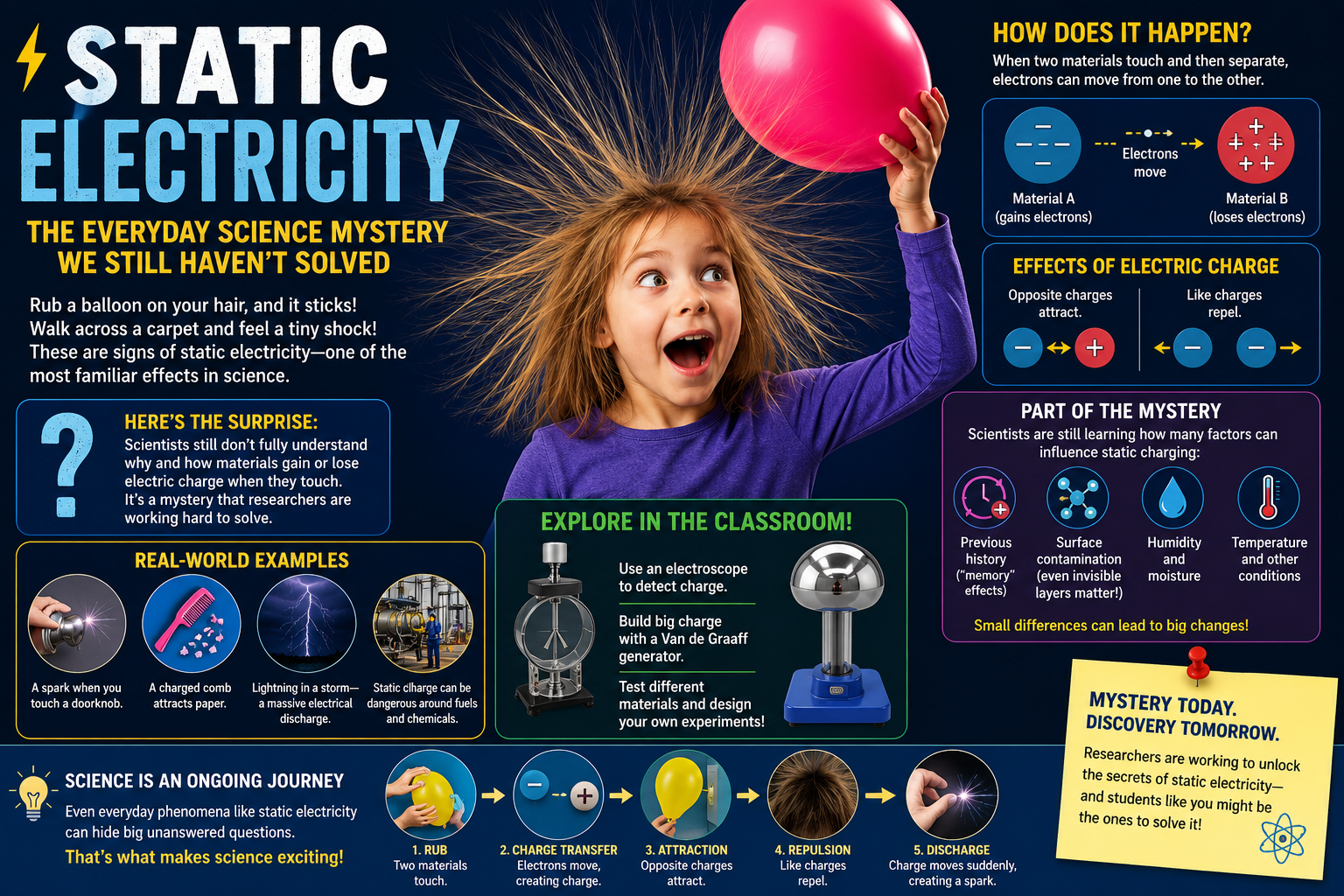
The basic explanation seems straightforward: electric charge moves between materials, leaving one object with an excess of negative charge and another with a deficit. Opposite charges attract. Like charges repel.
But there's a surprising twist.
Scientists still don't completely understand why contact between materials produces static charge the way it does.
A recent Science News feature on the mystery of static electricity explores how researchers are trying to solve questions surrounding a phenomenon humans have observed for thousands of years.
It turns out that the balloon sticking to the wall may be demonstrating not only a basic principle of physics, but also an active area of scientific research.
What Is Static Electricity?
Everything around us is made of atoms.
Atoms contain positively charged protons, negatively charged electrons, and electrically neutral neutrons.
An object normally contains roughly equal amounts of positive and negative charge, making it electrically neutral overall.
But electrons can sometimes be transferred between materials.
When two materials come into contact and then separate, one may end up with an excess of negative charge while the other is left relatively positive.
Unlike electric current moving continuously through a wire, these charges can accumulate on the surfaces of materials.
That's where the word static comes from.
The charge remains in place until it finds a way to move somewhere else.
Sometimes that movement is gentle enough that we don't notice it.
Other times, it's a spark.
Why Does Rubbing a Balloon on Your Hair Work?
The classic balloon experiment demonstrates a phenomenon scientists call contact electrification, often associated with the triboelectric effect.
When two different materials repeatedly touch and separate—as happens when you rub a balloon against hair—electric charge can be transferred between their surfaces.
The balloon and hair can end up with opposite net charges.
Because opposite charges attract, individual strands of hair are attracted toward the balloon.
At the same time, similarly charged strands of hair repel one another.
The result?
Hair standing dramatically on end.
A charged balloon can also stick to a neutral wall. The balloon's charge can cause charges within the wall's material to shift slightly, creating an attractive interaction.
It's a wonderfully simple classroom demonstration.
But explaining exactly why particular materials acquire particular charges turns out to be much more difficult.
Here's Where the Mystery Begins
Students often learn that certain materials simply have a greater tendency to gain or lose electrons.
A triboelectric series ranks materials according to their tendency to become positively or negatively charged after contact.
That can be useful for predicting what will happen in many experiments.
But it doesn't completely explain the underlying physics.
Researchers still debate exactly which charged particles are moving in different situations and what microscopic processes determine the direction and amount of charge transfer.
The puzzle becomes even stranger when scientists experiment with objects made from the same material.
If two objects are chemically identical, you might expect them to behave identically.
Yet two pieces of the same insulating material can sometimes develop opposite charges after contact.
Why?
That's one of the questions researchers are still trying to answer.
Materials May Have a Kind of Electrical "Memory"
Recent experiments have revealed an especially surprising clue.
The charging behavior of a material can depend on what happened to its surface previously.
Researchers have found that samples involved in earlier contacts can behave differently when they are used again.
In other words, a material's charging behavior can be influenced by its history.
Scientists sometimes describe this as a type of memory effect.
The material isn't remembering anything in the biological sense, of course. Instead, previous interactions may leave subtle physical or chemical changes on the surface that affect what happens during later contact.
That creates a major challenge for experiments.
Two samples that appear identical may not actually have identical surfaces.
One may have been handled differently.
One may have been rubbed before.
One may contain microscopic contamination.
One may have been exposed to different humidity.
All of those details can potentially affect the result.
Suddenly, a simple balloon experiment starts looking much more complicated.
Even an Invisible Layer on a Surface Can Matter
Another recent clue involves something that may be nearly impossible to see:
surface contamination.
Materials exposed to ordinary air can gradually collect extremely thin layers of carbon-containing molecules.
Researchers have found evidence that these surface layers can affect whether certain insulating materials tend to become positively or negatively charged.
That means the electrical behavior of an object may depend not only on what the object is made from, but also on what's sitting on its surface.
Imagine two apparently identical pieces of material.
To our eyes, they're the same.
At the microscopic and molecular level, however, their surfaces might be quite different.
Those differences could help determine how charge moves between them.
It's a wonderful example of why scientists sometimes discover that a familiar classroom explanation is only the beginning of the story.
Humidity Can Change the Experiment Too
Anyone who has experienced more static shocks during winter may already have noticed another important variable:
humidity.
Dry conditions generally make it easier for static charge to accumulate.
When the air contains more moisture, thin layers of water can form on surfaces and provide pathways that allow accumulated charge to dissipate more readily.
That's one reason static electricity often seems particularly noticeable indoors during cold, dry winter weather.
For students, humidity introduces an excellent experimental variable.
Does rubbing the same materials together produce the same result on a humid day and a dry day?
Does the number of times the materials are rubbed matter?
Does surface cleanliness matter?
Does temperature matter?
Does the amount of contact matter?
These questions transform a demonstration into an experiment.
Static Electricity Can Create a Spark
Suppose you've accumulated excess charge by walking across a carpet.
Then you reach for a metal doorknob.
The difference in electric potential between your body and the conductor can become large enough that charge suddenly moves through the air.
For a brief moment, the air itself becomes electrically conductive.
A tiny electrical discharge occurs.
You see a spark.
You feel a shock.
On a much larger scale, similar principles are involved in one of nature's most spectacular electrical events:
lightning.
Storm clouds can develop enormous regions of separated electric charge. When the electric field becomes strong enough, the air can break down electrically and a massive discharge can occur.
The spark from your finger and a bolt of lightning are obviously very different in scale, but both remind us that accumulated electric charge eventually looks for a path to move.
Static Electricity Isn't Always Harmless
A balloon sticking to a wall is entertaining.
A spark in the wrong environment can be dangerous.
Static charge is an important concern in industries involving flammable liquids, gases, powders, fuels, and sensitive electronics.
An electrical discharge can potentially ignite certain combustible mixtures.
Even when fire isn't a concern, static electricity can damage delicate electronic components.
That's why electronics technicians may use grounding straps and other electrostatic-discharge precautions when handling sensitive devices.
Engineers therefore need to understand not only how static charge accumulates, but also how to control it.
That makes today's research into contact electrification much more than an academic curiosity.
Scientists Are Also Finding Ways to Put It to Work
Static electricity isn't simply a problem to eliminate.
Researchers and engineers are finding ways to use the same physical processes to generate useful electrical energy.
Devices called triboelectric nanogenerators, or TENGs, can convert mechanical movement into electrical energy using contact electrification and electrostatic effects.
Imagine capturing energy from:
Walking.
Vibrations.
Moving fabric.
Wind.
Waves.
Repeated contact between materials.
The amount of energy from an individual interaction may be small, but these technologies could potentially power sensors and other low-energy devices.
The same phenomenon responsible for socks sticking together in the dryer may therefore contribute to new methods of harvesting energy.
Bringing Static Electricity Into the Science Classroom
One reason static electricity is such a valuable teaching topic is that students can experience it directly.
You don't need sophisticated equipment to begin asking scientific questions.
A balloon, hair, bits of paper, fabric, and other common materials can reveal attraction, repulsion, charge transfer, and polarization.
But classroom equipment can take those observations further.
An electroscope, for example, allows students to detect the presence of electric charge and investigate how charge can be transferred.
A Van de Graaff generator makes it possible to accumulate much larger amounts of static charge, producing dramatic demonstrations of attraction, repulsion, electrical discharge, and the behavior of charged objects.
Electrostatics equipment can help students move beyond simply observing that static electricity exists and begin investigating how electric charge behaves.
Explore Go Science Crazy's electricity and electrostatics equipment to find hands-on tools for bringing these concepts into the classroom.
Try Turning the Demonstration Into an Investigation
Instead of telling students exactly what will happen, give them several materials and ask them to investigate.
They might test:
-
A balloon
-
Wool
-
Cotton
-
Plastic
-
Paper
-
Glass
-
Different synthetic fabrics
Have students bring different pairs of materials into contact and then test whether the objects attract small pieces of paper or affect an electroscope.
Then change one variable.
Try rubbing the materials more times.
Clean one surface but not another.
Test on days with different humidity.
Use materials that have already been rubbed and compare them with materials that haven't.
Ask students to record their observations and look for patterns.
Then pose the question:
Can you create a rule that correctly predicts what every combination will do?
Students may quickly discover something researchers studying contact electrification already know.
Static electricity can be surprisingly inconsistent.
And that inconsistency isn't necessarily bad experimental technique.
It may be part of the scientific mystery.
What Makes a Good Scientific Explanation?
Static electricity also provides an opportunity to discuss something larger than electricity.
It demonstrates how scientific explanations change as evidence improves.
The classroom model that electrons can move between materials is useful.
It helps explain many observations.
But useful models aren't necessarily complete descriptions of everything happening at the molecular level.
Scientists can simultaneously say:
"We understand important principles behind this phenomenon."
and
"There are still important things we don't understand."
Those statements aren't contradictory.
They're how science works.
A scientific model doesn't need to answer every possible question to be useful. New experiments reveal limitations, researchers revise explanations, and better models emerge.
That's exactly what's happening with static electricity today.
A Mystery Hiding in Plain Sight
Static electricity has been observed for thousands of years.
It's demonstrated in elementary classrooms.
It's responsible for balloons sticking to walls, clothes clinging together, tiny shocks from doorknobs, and dramatic hair-raising demonstrations.
Yet researchers are still working to explain some of its most basic behavior.
Why do particular materials become positively or negatively charged?
Why can identical materials sometimes develop opposite charges?
How much does surface contamination matter?
Why does a material's previous history affect later charging?
And can scientists develop a model that reliably predicts what will happen when two surfaces touch?
Those unanswered questions make static electricity an especially valuable lesson for students.
Science isn't just the study of things we already understand.
Sometimes the most interesting scientific mysteries are hiding inside phenomena so familiar that we stopped wondering about them.
The next time a balloon makes your hair stand on end, remember:
You're watching a physics experiment that scientists are still trying to fully explain.
Read More About the Research
Explore the Science News feature, "Static electricity is a mystery, and scientists are all charged up" to learn more about the researchers working to understand contact electrification.
For a deeper look at the recent research, read Nature's “Leading the charge to explain static electricity”.
Watch: How Triboelectric Charging Works
For a classroom-friendly demonstration and explanation, watch The Physics Classroom's:
The video demonstrates charging by contact, explains the resulting positive and negative charges, and introduces the triboelectric series as a way of predicting how different materials may become charged.