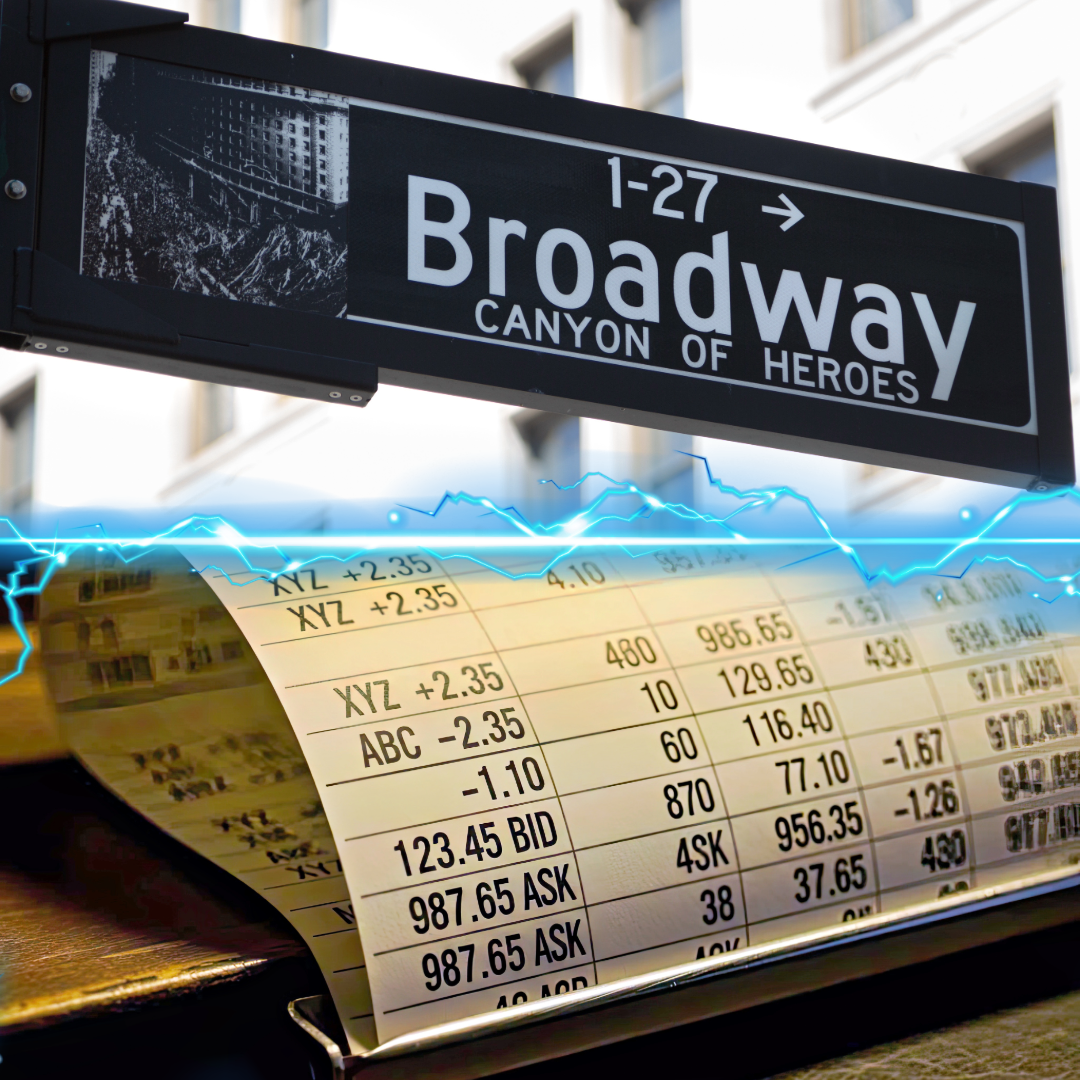
This morning, thousands of New Yorkers crowded sidewalks and sports bars to get a glimpse of their Knicks in the team's first ticker-tape championship parade. It's a celebration 53 years in the making for a franchise and its fans. But tucked inside that blizzard of confetti is a science story that most people in the crowd never think about.
The tradition is called a ticker-tape parade for a reason, and while sports science often deals with force and motion, this parade feels...electric.
Why Is It Called Ticker Tape?
The name comes from a very specific piece of paper: the narrow, continuous strip printed by stock ticker machines that once filled brokerage offices and financial exchanges across the country. These machines produced a constant stream of paper tape printed with stock prices, company abbreviations, and transaction data. The tape was thin, lightweight, and produced in enormous quantities. When New York City held its first impromptu ticker-tape parade in 1886 to celebrate the dedication of the Statue of Liberty, office workers simply threw what they had on hand out the windows. What they had was ticker tape.
The tradition stuck. For decades, the tape itself was the confetti. Today the paper is shredded from office documents and phone books, but the name has never changed, and neither has the basic spectacle of paper falling through lower Manhattan.
What Was a Stock Ticker Machine?
A stock ticker machine was not a simple printer. It was an electromechanical device connected to a telegraph network, and understanding how it worked means understanding the science that made it possible.
The machines were developed in the 1860s and refined significantly by Thomas Edison, whose 1869 Universal Stock Ticker became the standard for financial exchanges. These devices received electrical signals transmitted over telegraph lines and converted those signals into mechanical motion that pressed inked type against a moving paper tape. The result was a continuous printed record of financial data delivered in near real time across a city or even across the country.
What made this remarkable was not just the mechanical ingenuity. It was the fact that information was being encoded as electrical signals, transmitted over wire, decoded by a receiving device, and converted into a physical, readable output. That sequence, encode, transmit, receive, decode, output, is the same basic architecture underlying every digital communication system in use today.
How Telegraph Technology Made It Possible
The stock ticker was an extension of telegraph technology, which had been transforming long-distance communication since the 1840s. The telegraph worked by opening and closing an electrical circuit in patterns that corresponded to coded information. In the Morse system, short and long pulses, dots and dashes, represented letters and numbers. An operator at one end of a wire tapped a key to interrupt the circuit in specific patterns. At the other end, a receiver detected those interruptions and either printed them, sounded them as clicks, or displayed them mechanically.
The science underneath this is foundational. A telegraph circuit required a power source, a conductor, a switch, and a receiver. When the circuit was closed, current flowed. When it was open, it stopped. The receiver at the far end used an electromagnet, a coil of wire wrapped around an iron core that became magnetic when current passed through it, to detect those pulses. The electromagnet would attract a small armature, producing a click or driving a mechanical action, then release it when the current stopped. Rapid sequences of attraction and release translated electrical signals into information.
This was not a metaphor for modern technology. It was the literal beginning of it. The telegraph was the first system to transmit information faster than a human being could physically travel, and it did so using nothing more than wire, current, and the predictable behavior of electromagnetism.
How Electrical Signals Became Printed Output
The leap from telegraph to stock ticker was a matter of automation and precision. Rather than requiring a human operator to interpret incoming signals and write them down, ticker machines used the incoming electrical pulses to drive a mechanical printing mechanism directly. The electromagnet in the receiver would respond to each signal, and through a series of gears, escapements, and type wheels, that response would advance the tape and press the correct character onto it.
Every printed letter on a ticker tape was, at its origin, an electrical pulse sent over a wire. Every pulse was the result of a circuit being closed and opened in a specific pattern. Every pattern was a piece of encoded information. The machine was doing automatically what a telegraph operator did manually, reading electrical signals and converting them into human-readable output.
As Scientific American has noted, the stock ticker represented one of the earliest examples of automated information processing, a machine that could receive, interpret, and record data without direct human intervention at the receiving end. That is a genuinely significant moment in the history of technology, and it happened because of electromagnets.
Why This Still Matters in the Science Classroom
The concepts at work in a telegraph receiver or a stock ticker machine are not historical curiosities. They are the same concepts that appear in NGSS performance expectations around energy transfer, electromagnetic phenomena, and the relationship between electric current and magnetic fields. The history just makes them easier to care about.
When students understand that a parade tradition traces back to a machine that used electromagnets to convert electrical signals into mechanical motion, abstract physics becomes a story with a beginning, a middle, and a very recognizable ending. The Canyon of Heroes is the ending. The electromagnet is the beginning.
A Dissectible Electromagnet gives students a direct, hands-on way to explore exactly the principle that made telegraph receivers and ticker machines work. Because the electromagnet can be taken apart and reassembled, students can see the coil, the iron core, and the relationship between them before the device is energized. When current flows, the core becomes magnetic. When it stops, the magnetism disappears. That on-off behavior, controlled by a circuit, is precisely what allowed a telegraph receiver to respond to incoming signals and drive mechanical output. Holding the components in their hands and watching the effect appear and disappear makes the connection between electricity and magnetism concrete in a way that a diagram rarely achieves.
Old Technology, Enduring Science
There is something worth pausing on in the image of confetti falling over Broadway. The paper is a remnant of a machine that most people alive today have never seen in operation. The parade tradition outlasted the technology that named it by decades. But the science that made the original ticker tape possible, circuits, electromagnets, encoded signals, mechanical response to electrical input, is still being taught in physics and physical science classrooms because it still explains how the world works.
The next time a parade moves through the Canyon of Heroes, it is worth knowing that the name in the headline connects to one of the most consequential technological developments in modern history. And that the same principles a nineteenth-century engineer used to print stock prices on a paper strip are the ones your students can explore on a lab bench today.