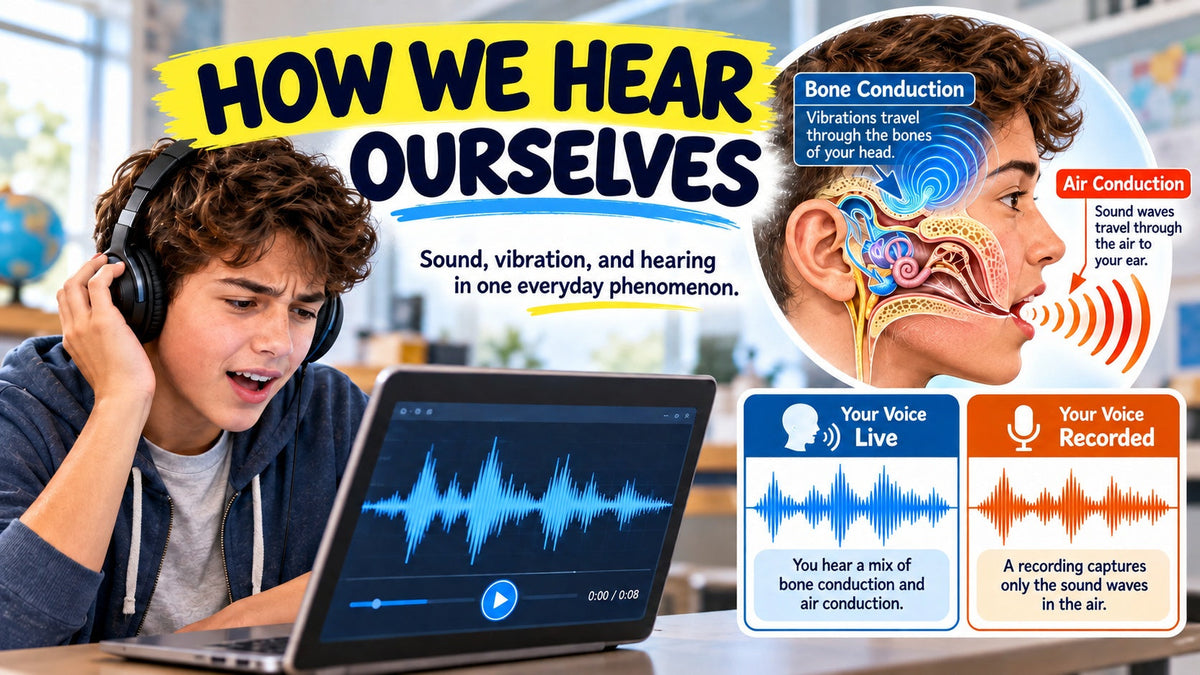
What Your Own Voice Can Teach Students About Sound, Vibrations, and Hearing
Ask students to record themselves speaking and then play the recording back.
There is a good chance at least one student will immediately say:
“That doesn’t sound like me.”
It is a familiar experience, but it opens the door to a surprisingly rich science lesson.
Why does your voice sound different in a recording? How does sound actually reach the inner ear? What role do vibrations play? How can students collect evidence about something they experience every day?
A simple voice recording can become a starting point for investigating waves, vibration, frequency, sound transmission, hearing, and scientific models.
And it begins with something every student already has access to: their own voice.
Sound Begins With Vibration
Before students can understand why a recorded voice sounds different, they need a clear model of how sound begins.
When we speak, air from the lungs passes through the larynx and causes the vocal folds to vibrate.
Those vibrations create pressure changes in the surrounding air.
The disturbance travels outward as a mechanical wave.
Eventually, those pressure changes may reach another person's ear, causing structures in the ear to vibrate and allowing the nervous system to process the signal as sound.
That basic sequence gives students a useful model:
Vibration → Mechanical Wave → Ear → Sensory Information
But when you listen to your own voice while speaking, there is another pathway involved.
Two Paths to Your Inner Ear
When another person speaks to you, you hear their voice primarily through air conduction.
Sound waves travel through the air, enter the ear canal, and contribute to vibrations that are ultimately detected by the inner ear.
When you speak, you hear your voice through air conduction too.
But you also experience vibrations traveling through tissues and bones in your head.
This is called bone conduction.
That means your everyday perception of your own voice is a combination of more than one pathway.
A recording is different.
When a microphone records your voice and a speaker plays it back, you are primarily hearing the air-conducted version of your voice. The bone-conducted component that accompanies speaking is missing.
Research into self-voice perception identifies this missing bone-conduction component as an important reason recorded voices can sound unfamiliar. Bone conduction can also emphasize lower-frequency components of the voice, contributing to the difference students notice. PubMed Central (PMC)
Suddenly, the familiar complaint that "my recorded voice sounds weird" becomes evidence of how sound reaches the auditory system.
Turn the Experience Into a Prediction
Before explaining any of this to students, let them experience it.
Ask:
Will your recorded voice sound exactly like the voice you hear while speaking?
Students can make a prediction first.
Then have them record the same short sentence.
For example:
“Sound is energy transferred through vibrations.”
Play the recording back.
Have students describe what they notice before giving them an explanation.
Possible observations might include:
- My voice sounds higher.
- My voice sounds thinner.
- It sounds unfamiliar.
- The volume is different.
- Certain sounds are more noticeable.
- It sounds more like the voice other people hear.
The goal is not to decide whose description is correct.
The goal is to move from:
“That sounds strange.”
to:
“What could explain the difference?”
That shift is where the investigation begins.
Let Students Feel the Vibration
Sound is often introduced through diagrams of waves.
Those models are useful, but students should also have opportunities to connect the model to physical evidence.
Have students gently place two fingertips on the front of their throat while speaking.
Try several sounds:
“Ahhh.”
“Mmmmm.”
A high-pitched sound.
A low-pitched sound.
A louder sound.
A quieter sound.
Ask:
What can you feel?
Students should notice vibration.
Now ask:
What changes when you change the sound?
This creates an opportunity to connect their observations to frequency, amplitude, and the production of sound.
The experience also reinforces an important point:
Sound is not simply something we hear. It originates with physical vibration.
Compare Speaking, Humming, and Listening
A simple comparison can help students build a stronger model.
Have students compare four experiences:
1. Speak Normally
Students hear their voice through the normal combination of pathways involved in speaking.
2. Listen to a Recording
Now the sound comes back through the surrounding air and audio equipment.
3. Hum With Ears Gently Covered
Students may notice that humming remains surprisingly noticeable.
4. Place Fingers Gently Against the Throat While Humming
Students can feel the vibration associated with sound production.
Ask students to create an explanation that accounts for all four observations.
A useful model should explain why:
- Sound can travel through air.
- Vibrations can travel through solids and tissues.
- The same voice can be perceived differently depending on how vibrations reach the auditory system.
Students are now using evidence to refine a model instead of memorizing definitions.
Bring Measurement Into the Investigation
The lesson becomes even stronger when students move beyond qualitative observations.
A microphone or digital audio application can make sound visible as a waveform.
Have students record several sounds while changing one variable at a time.
For example:
Investigation 1: Change Volume
Record the same vowel quietly and loudly.
Ask:
What changes in the waveform?
Students can investigate the relationship between sound intensity and wave amplitude.
Investigation 2: Change Pitch
Record a low note followed by a higher note.
Ask:
What changes?
Students can connect pitch to frequency.
Investigation 3: Compare Different Vowel Sounds
Record:
- Ah
- Ee
- Oh
Ask:
If the pitch is similar, why don't the waveforms look exactly the same?
That question introduces the idea that real sounds are more complicated than simple textbook sine waves.
From Simple Waves to Complex Sounds
Students often encounter drawings of perfectly smooth waves when first learning about sound.
Those diagrams help illustrate concepts such as:
- Wavelength
- Frequency
- Amplitude
- Period
But a human voice produces a complex signal.
The vibration of the vocal folds creates a fundamental frequency along with additional frequency components. The vocal tract then influences the resulting sound.
That is why two people can speak the same word at approximately the same pitch and still sound different.
It is also why musical instruments can play the same note but remain recognizable as different instruments.
This creates a useful teaching connection between wave models and real-world sound.
A model does not need to reproduce every detail to be useful.
It needs to help explain the phenomenon being investigated.
Ask Students Which Version Is the “Real” Voice
Here is a question that can generate excellent discussion:
Which is your real voice, the one you hear while speaking or the one on the recording?
Students may initially want to choose one.
But scientifically, the situation is more interesting.
Both experiences represent sound associated with the same vocal source.
What changes is the pathway through which the vibration reaches the listener.
While speaking, self-voice perception includes air-conducted sound plus bone-conducted and other sensory information. A normal recording played through a speaker does not recreate that full experience. Research describes natural self-voice perception as involving multiple sensory components, not simply an air-conducted sound signal. PubMed Central (PMC)
This is a useful example of why scientific explanations often move beyond either-or answers.
Connect Sound to Structure and Function
This topic can also bridge physics and life science.
Students studying waves can ask:
How does sound travel?
Students studying biology can ask:
How does the body detect those vibrations?
Students studying engineering can ask:
How does a microphone convert vibrations into a signal that can be stored and reproduced?
The same phenomenon can support multiple science disciplines.
That makes it especially useful for helping students recognize that science concepts do not exist in isolated units.
Classroom Investigation: Build an Evidence Table
Instead of giving students a worksheet filled only with definitions, try an evidence table.
| Observation | Evidence | Possible Explanation |
|---|---|---|
| My recorded voice sounds different | Recording sounds different from live speaking | Recording lacks the same bone-conduction experience |
| I can feel my throat vibrating | Physical vibration occurs while speaking | Sound originates from vibration |
| Humming is noticeable with ears covered | Vibrations can still reach the auditory system | Sound is not reaching us only through the open ear canal |
| High and low sounds create different wave patterns | Digital waveform or frequency display changes | Frequency relates to perceived pitch |
Now students are connecting observations to scientific explanations.
That is much closer to how scientific reasoning actually works.
Move From “What Happened?” to “What Evidence Supports It?”
A useful change in classroom questioning is to stop after the observation and ask for evidence.
Instead of:
Why does your voice sound weird?
Try:
What evidence suggests that more than one sound-transmission pathway is involved when you hear yourself speak?
Instead of:
What is frequency?
Try:
What happens to your recorded waveform when you produce a higher-pitched sound?
Instead of:
What is amplitude?
Try:
What measurement or observation changes when you make the sound louder?
The vocabulary is still important.
But students encounter the vocabulary as a tool for explaining evidence rather than as an isolated list to memorize.
NGSS Connections
This topic can support several NGSS-related learning goals without implying that one voice-recording activity satisfies an entire performance expectation.
For middle school, MS-LS1-8 asks students to gather and synthesize information about how sensory receptors respond to stimuli and send information to the brain. Sound and hearing provide a relevant context for discussing sensory input. Next Generation Science Standards
Sound investigations can also reinforce Science and Engineering Practices such as:
- Developing and Using Models
- Planning and Carrying Out Investigations
- Analyzing and Interpreting Data
- Constructing Explanations
- Using Mathematics and Computational Thinking
Teachers can adjust the depth of the investigation depending on grade level.
Middle school students might focus on vibration, frequency, amplitude, and observations.
High school students can extend the investigation into waveform analysis, frequency spectra, resonance, signal processing, or the physics of hearing.
The Bigger Classroom Opportunity
The most useful science questions are not always the most complicated.
Sometimes they begin with something students have experienced hundreds of times:
Why does my voice sound different when I record it?
That one question can lead students into:
- Mechanical waves
- Vibrations
- Frequency
- Amplitude
- Sound transmission
- Bone conduction
- Hearing
- Experimental design
- Digital measurements
- Scientific modeling
That is exactly the kind of connection that makes science feel less like a collection of separate facts and more like a way of explaining the world students already experience.
The next time a student hears a recording and says:
“That doesn't sound like me.”
You have a science investigation ready to begin.